Products
Best Lunch Boxes for Kindergarten (2026 Buying Guide)
Lunch box for kindergarten buying guide: hard vs soft, age bands, what to avoid, bento compartments, thermos wells, dishwasher care, backpack fit, short lunch periods, USDA FSIS / CDC packing notes, spill risk, and five Amazon picks.
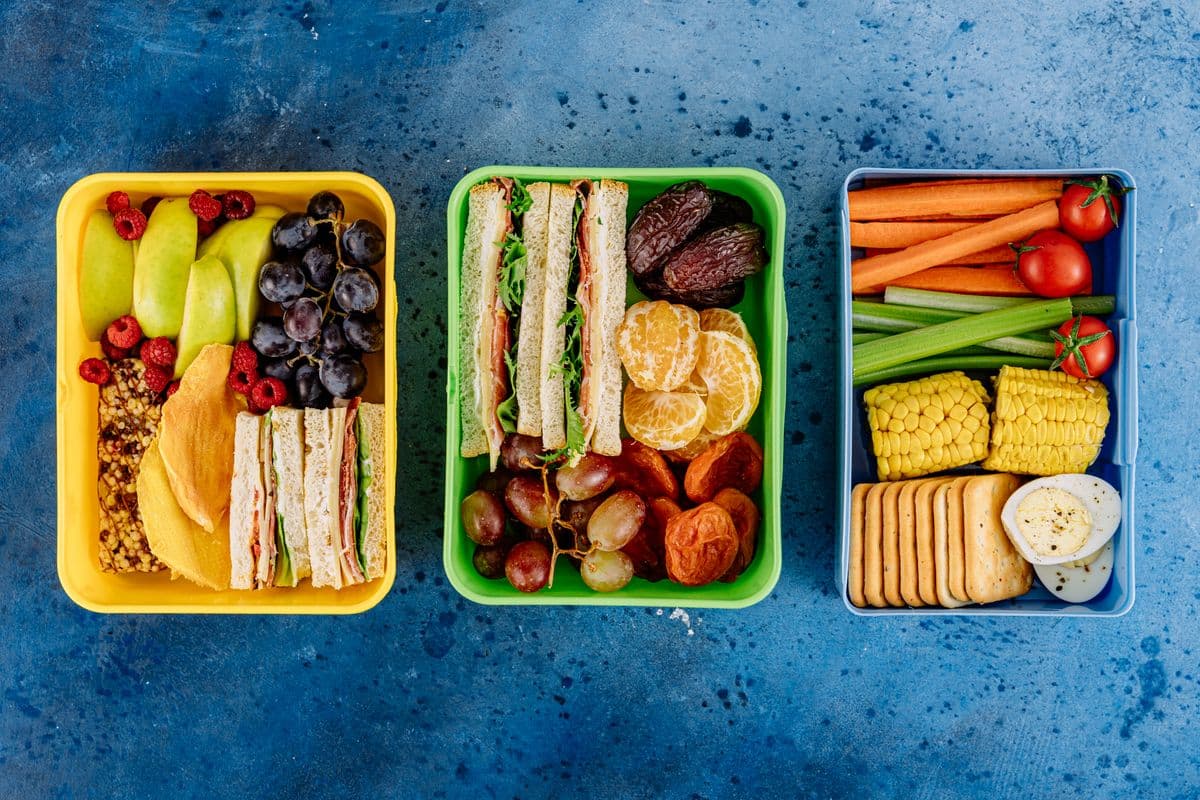
As an Amazon Associate I earn from qualifying purchases.Some links on this page are affiliate links. If you buy through them, Mom's Magazine may earn a small commission at no extra cost to you. It never changes which products we recommend. How we recommend products.
The best lunch box for kindergarten is one a five-year-old can open alone, that fits the backpack beside folders, and that matches how you pack: sealed bento for wet sides, stainless tray for dry packing, or a thermos-well unit when warm food is daily. Kindergarten lunch periods are short and classrooms often have no fridge — pack for spill risk and the USDA FSIS Danger Zone (keep perishables cold with an insulated bag plus cold sources, commonly framed as at least two). Hard-sided bentos protect sandwiches; soft insulated bags are the cold carrier (many families use both). Dishwasher rules vary by part — dry seals fully. Our Recommendations keep five Amazon picks on this page — not a scored ranking, and we do not hard-code prices.
Best Overall
Bentgo Chill Kids Lunch Box
Best for: Everyday leak-resistant lunches with a built-in ice pack option
Quick picks
| Product | Best for | |
|---|---|---|
| Bentgo Chill Kids Lunch Box Best Overall | Everyday leak-resistant lunches with a built-in ice pack option | Check price on Amazon |
| Yumbox Original Leakproof Bento Easiest to Open | Little hands who open lunch themselves | Check price on Amazon |
| OmieBox Bento Box for Kids Best for Hot Food | Packing soup or warm leftovers beside cold sides | Check price on Amazon |
| PlanetBox Rover Stainless Lunchbox Most Durable | A stainless multi-compartment tray built to last | Check price on Amazon |
| LunchBots Large Cinco Stainless Best Stainless | Plastic-free simplicity for dry foods | Check price on Amazon |
The best lunch box for kindergarten is the one a five-year-old can open, eat from, and close alone in a short cafeteria window — usually without a teacher standing by. Looks, character prints, and online hype matter less than a simple latch, a footprint that fits the backpack, and a packing setup that keeps perishable food safely cold until lunch. This guide walks through how to choose, what USDA food-safety pages actually say about packed lunches, how bento trays compare with classic boxes and insulated bags, cleaning routines that prevent mildew, and how to use the five real Amazon options already listed in Our Recommendations without treating them as a scored ranking.
Mom's Magazine may earn a commission when you buy through links on this page. Tap through the product cards below for live Amazon availability, and check the listing before you buy.
Start with independence, not Instagram
Kindergarten lunch periods are short. Staff are stretched across a whole room. If the box needs an adult, your child may spend the period waiting — or skip eating. Before you buy, put the candidate on the kitchen table and run a practice loop: open, "eat," close, repeat. Do it when your child is tired, not only when they are fresh, because that is closer to a real school day.
The 15-minute dry run
Set a timer for about 15 minutes. Have your child open the box, move food (or play food) out and back, and latch it shut. If they cannot manage the container in that window after a few practices, it is the wrong box for this year — no matter how cute the print is.
- Prefer a single, obvious latch over multi-clip lids that fight little fingers.
- Watch for lids that need two hands plus a thumb press; many five-year-olds can learn them, but practice first.
- Skip novelty locks that look fun in photos and stall a hungry kindergartner.
- Label the lid and the base. Lost-and-found fills up fast in week one.
Check Bentgo Chill Kids on AmazonAffiliate link. Easy-open latch with removable ice pack tray.
What actually matters at ages 5–6
Once openability is settled, the next filters are leak behavior, cleanability, backpack fit, and portion reality. Kindergartners often eat less than packing blogs suggest. A giant box invites waste and a heavier backpack; a tiny tray sends them home hungry. Match the box to the appetite you already see at home.
| Feature | Why it matters in kindergarten |
|---|---|
| Kid-openable latch | Lunch only happens if they can open the box alone. |
| Leak resistance where you need it | Yogurt, fruit cups, and sauces ruin homework when seals fail. |
| Dishwasher-safe parts you will use | Nightly hand-washing every part is how boxes get abandoned. |
| Backpack footprint | If it does not slide in cleanly, it gets crushed or left at home. |
| Honest portion size | Pack what they finish — not what looks full for a photo. |
Also ask your school how lunch works: do kids eat in a cafeteria, classroom, or outdoors? Is there a fridge? How long is the period? A beautiful leakproof bento still fails if it does not fit the cubby or the routine.
Bento tray, classic box, or insulated bag?
These are tools, not teams. Many families use more than one.
- Leak-resistant bento trays: Separate foods without a pile of baggies. Great for variety and picky eaters who like compartments. Portions are fixed, so you pack around the wells.
- Classic single-compartment boxes: Roomier for wraps, taller sandwiches, or leftovers. Simpler geometry; you may still want small containers for wet sides.
- Stainless multi-compartment trays: Durable and plastic-light on the food surface. Many are not sealed between wells — pack dry foods or use separate dip cups.
- Insulated lunch bags: The carrier that keeps cold sources against the food. USDA guidance for bag lunches focuses on keeping perishables cold — the bag is part of the safety plan, not an optional fashion accessory.
A common kindergarten setup is a bento or stainless tray inside an insulated bag with cold sources. That combination covers openability, packing variety, and temperature control better than any single product claim.
Check Yumbox Original on AmazonAffiliate link. One-latch leakproof tray for variety packing.
When the tray is sorted and you still need the meal cold until noon, insulated lunch bags for kids covers soft-sided carriers — the other half of the box-inside-bag setup USDA FSIS describes.
Food safety for packed lunches (USDA / FSIS)
Young children are more vulnerable to foodborne illness, which is why packing cold (or hot) correctly matters as much as picking a cute box. The U.S. Department of Agriculture's Food Safety and Inspection Service (FSIS) publishes clear guidance on keeping bag lunches safe. We summarize their public pages here; read the linked sources for the full text.
- Perishable food sits in the "Danger Zone" between 40°F and 140°F, where harmful bacteria can multiply quickly (USDA FSIS).
- FSIS recommends insulated soft-sided lunch boxes or bags for keeping food cold, and packing at least two cold sources with perishable food — for example two frozen gel packs, or a gel pack plus a frozen juice box or frozen water bottle — placed above and below the perishables.
- Brown paper bags are a weak cold holder; as ice packs thaw, paper weakens and cold air escapes (USDA back-to-school lunch safety reminders).
- For hot foods such as soup or chili, FSIS describes using an insulated container: fill with boiling water, let it stand a few minutes, empty, add the hot food, and keep the lid closed until lunch so food stays hot.
- Pack only what will be eaten at lunch when you can. Leftovers that sat warm are a storage problem; FSIS advises discarding leftover perishable food and used packaging rather than saving questionable items.
- Food should not sit at room temperature more than 2 hours — 1 hour if the air is above 90°F (FSIS bag-lunch guidance).
Editorially reviewed general information
This section restates public USDA / FSIS consumer guidance for packed lunches. It is not a personal medical or food-lab test of any brand. If your child has a medical condition that affects what they can eat or how food must be stored, follow their clinician's and school's instructions.
Practical translation for kindergarten mornings: freeze the gel packs overnight, pack perishables between cold sources, keep the insulated bag closed until lunch, and wash the box when it comes home. If the school has a refrigerator and allows it, ask whether perishable items can go there on arrival.
Check OmieBox (hot + cold) on AmazonAffiliate link. Built-in insulated food jar for warm sides.
Packing notes that matter at this age
- Practice the latch at home for several days before the first school morning.
- Send a napkin and a water bottle your child can open alone — see our related water-bottle guide.
- Skip runny foods in trays that are not sealed between compartments (many stainless trays are not).
- Keep wet sides in sealed dip cups or in a jar designed for liquids.
- Pack familiar foods for the first weeks; novelty boxes plus brand-new menus is a lot of change at once.
- Put your name and phone or email on lid and base with a dishwasher-safe label.
Related reading on this site: school lunches that do not need refrigeration, best water bottles for kids, and best backpacks for elementary school.
Packing for a kindergartner often sits next to a younger sibling still on cups. Our sippy cup roundup covers spoutless and weighted-straw picks, and open cups for babies covers the open-rim path that pairs with early solids. For the cold carrier next to this lunch box, stay with insulated lunch bags for kids.
Allergy policies and school rules
Before you invest in a system, read the classroom allergy letter. Nut-free tables, no-share rules, and thermos policies vary by school. A perfect leakproof bento still fails if it cannot go through the lunch line your school actually runs. Ask whether teachers open containers, whether glass is banned, and whether ice packs are allowed in cubbies. Build your packing kit around those constraints first, then pick the box.
Cleaning and mildew prevention
A lunch box that is hard to dry becomes a mildew box. Removable seals and gaskets are a feature only if you actually remove and dry them. Manufacturer care differs by brand — follow the product page — but a kindergarten-proof routine looks like this:
- Empty crumbs and rinse the same day; do not zip a damp insulated bag shut overnight.
- Wash trays and lids per the maker's instructions (top-rack dishwasher vs hand-wash).
- Pull silicone seals and gaskets when the design allows; wash, rinse, and air-dry fully before reassembly.
- Air-dry all parts overnight with the bag open so moisture is not trapped in foam or fabric layers.
- Once a week, do a deeper wipe of the insulated bag interior; crumbs in seams are where smells start.
OmieBox care note
OmieLife's own care guidance says OmieBox should be hand-washed (not dishwasher), with the lid seal and thermos gasket removed and dried daily. Do not assume every "bento" is dishwasher-safe — check the listing.
Durability vs. the character-print trap
Prints get kids excited to carry lunch. They also go out of fashion, peel, or make a box harder to replace when one part breaks. When two options are otherwise equal, prefer:
- Replaceable lids, seals, or dip cups so one broken piece does not trash the whole system.
- Simple colorways you can still buy next year.
- Hinges and latches that look serviceable, not decorative only.
- A weight your child can carry — stainless lasts, but some trays are heavier than plastic shells.
Stainless trays such as PlanetBox Rover and LunchBots Cinco are built for long use, but they are not magic: if the wells are not sealed, yogurt still needs a dip cup. Plastic leak-resistant bentos trade some longevity for easier wet-food packing. Pick for how you actually pack, not for a material purity contest.
Common mistakes that waste a good box
- Buying before the openability test — the number-one return reason in real kitchens.
- Overpacking "balanced" lunches the child never finishes at home either.
- Sending perishables in a thin bag with no cold source on a warm day.
- Assuming every compartment is leakproof because the marketing said "bento."
- Never drying seals — mildew shows up as "mystery smell" by October.
- Skipping labels — identical blue boxes are a classroom classic.
Cafeteria time windows: pack for the clock you actually have
Kindergarten lunch periods are often short — many schools budget roughly 15–25 minutes for the whole class to walk to the cafeteria, sit, open food, eat, and clean up. That is not a leisurely family meal. A lunch that needs three hard latches, a thermos lid a child cannot twist, and a yogurt tube that requires adult scissors will lose to the clock. Pack so the first two minutes produce something edible, not a pile of unopened packaging.
Ask your school how long lunch actually runs and whether kids eat in a cafeteria, a classroom, or a multipurpose room. Some programs stagger classes; others release everyone at once into a loud room where asking a teacher for help means waiting in a line. Those logistics decide whether a sealed bento with one kid-friendly latch beats a beautiful multi-piece set that looks great on Instagram and fails at 11:40 a.m.
- Prioritize one main open (lid or latch) before secondary containers
- Pre-open or skip packaging that needs scissors or adult strength
- Pack familiar foods the first two weeks — novelty loses to time pressure
- Send a napkin or wipe your child will actually use without coaching
- Watch what comes home uneaten for a week before you redesign the menu
Time a practice lunch at home
Set a 15-minute timer once at the kitchen table. If your child cannot open, eat a reasonable portion, and close the box before the timer ends — with you only watching, not helping — simplify the box or the packing before the first school day.
Latch practice week: independence before day one
The single highest-ROI prep for kindergarten lunch is not a new print or a specialty snack — it is a week of latch practice at home. A five-year-old who can open and close the box alone eats more food and asks adults for help less often. Teachers cannot stand over every lunch box. Practice when nobody is rushing out the door.
- Day 1–2: empty box only — open, close, reopen until it feels boring.
- Day 3–4: add one easy food (crackers or dry cereal) so they practice with weight and a lid that resists a little.
- Day 5: full mock lunch with the insulated bag and cold packs you will actually use — open bag, remove box, open box, eat, close, return to bag.
- Weekend before school: one timed run that matches your school's lunch length.
If the latch still needs two adult hands after a week, that is a product fit problem, not a parenting failure. Switch to a simpler closure or a different model from Our Recommendations rather than hoping the cafeteria will teach fine motor skills under time pressure. Soft silicone seals that feel "stuck" to adults often feel impossible to kids; stainless clips that look sturdy can be easier once the motion is practiced.
Backpack fit: weight, footprint, and crushing sandwiches
A kindergarten backpack is small. Folders, a change of clothes, a water bottle, and a lunch system compete for the same space. A lunch box that barely zips in on the kitchen counter will crush the sandwich once books go on top, or it will force the water bottle into a side pocket where it falls out on the bus. Measure the main compartment and pack the real backpack once before you buy a second box.
- Fit test: lunch box + water bottle + one folder in the bag your child will carry
- Prefer a flatter footprint over a tall tower that tips the backpack
- Keep the heaviest cold pack against the perishable food, not loose in a side pocket
- If the bag has a dedicated lunch sleeve, confirm the box actually fits that sleeve
- Label the box and bag — identical blues and pinks are a classroom classic
Pairing matters. An insulated lunch bag that fits the box you chose is more useful than a character tote that leaves the ice pack floating in a corner. We cover insulated bags separately in best insulated lunch bags for kids and water bottles in best water bottles for kids — use those pages to complete the cold-and-hydration setup rather than treating the lunch tray as the whole system.
USDA FSIS cold-safety detail for school bag lunches
USDA Food Safety and Inspection Service (FSIS) guidance on keeping bag lunches safe is the backbone of the food-safety section on this page — not a blog tip recycled without a source. Harmful bacteria multiply quickly in the temperature "Danger Zone" between 40°F and 140°F. Perishable food transported without a cold source will not stay safe for long. Soft-sided insulated lunch bags are preferred for keeping food cold, and FSIS recommends packing at least two ice sources with perishable food in any lunch bag or box you use.
Practical packing that follows that guidance: freeze gel packs overnight; place cold sources above and below perishable items; keep cooked foods refrigerated at 40°F or below until you leave home; pack lunch bags right before leaving rather than leaving a packed bag on the counter overnight. FSIS notes you can combine a frozen gel pack with a frozen juice box or frozen bottle of water. If a refrigerator is available at school, store perishables there on arrival — and if the insulated bag itself goes in the fridge, leave it open so cold air can circulate.
Time limits matter too. FSIS advises that food should not sit at room temperature more than 2 hours — 1 hour if the temperature is above 90°F. A backpack left on a sunny bus seat or against a classroom window can exceed that threshold even when the outdoor forecast looked mild. After lunch, discard leftover perishable food and used packaging rather than saving mystery leftovers for the ride home. Whole fruits and vegetables, hard cheese, breads, crackers, and peanut butter (where school policy allows) are examples FSIS lists as safer without a cold source — still confirm your school's allergy rules before you pack nut products.
For hot lunches, FSIS describes using an insulated container: fill with boiling water, let stand a few minutes, empty, then add piping-hot food and keep the container closed until lunchtime so food stays hot (140°F or above). That is why thermos-style jars belong on this page as a hot-food option — not as a substitute for cold-chain packing when you send a turkey sandwich. Read the primary pages: Keeping Bag Lunches Safe (USDA FSIS) and Danger Zone 40°F–140°F (USDA FSIS). FoodSafety.gov also points families to the same bag-lunch cold-source advice for school and work lunches.
Not medical or cafeteria policy advice
This section summarizes public USDA FSIS / FoodSafety.gov handling guidance for packed lunches. It is not a diagnosis, not a school-district policy, and not permission to ignore your school's allergy or refrigeration rules. When guidance and school policy conflict, follow the school.
Pair the lunch box with an insulated bag and a water bottle
A latch-only bento is not a complete cold plan. If you pack yogurt, cheese, deli meat, cut fruit, or leftover pasta, you need an insulated bag plus cold sources as FSIS describes — and a water bottle that your child can open without flooding the table. Buying those as an afterthought the night before school is how families end up with a beautiful tray in a thin tote and a bottle that drips into the folder pocket.
Use this page for the lunch tray or box decision, then complete the system: best insulated lunch bags for kids for bags that actually hold two cold sources, and best water bottles for kids for bottles kindergarteners can open and close. Confirm current listings, sizes, and care notes on Amazon before you buy.
- Cold pack above and below the perishable compartment when possible
- Frozen water bottle can double as a cold source if it fits without crushing food
- Keep the water bottle outside the food tray so leaks do not soak lunch
- Wash bottle and lunch seals on the same nightly routine so mildew does not specialize in one item
Allergy labels and classroom norms (without medical advice)
Many kindergarten classrooms are nut-aware or nut-free; some post seating charts or require labeled containers. That is a school-operations and safety communication issue — not a place for this magazine to invent medical advice, diagnose allergies, or tell you which foods are "safe" for another child's condition. Read your school's written policy, ask the teacher how labeling works in practice, and pack accordingly.
- Label the lunch box and bag with your child's name in waterproof ink or a durable sticker
- If the school asks for ingredient notes on shared snacks, follow that process — do not improvise for other families
- When a policy bans peanuts or tree nuts, check labels for "may contain" statements, not only the ingredient list
- Sunflower-seed butter and other school-allowed swaps only help if your classroom policy accepts them — confirm first
- Never trade food in a classroom with allergy rules; teach that as a social rule, not a suggestion
If your child has a diagnosed food allergy or medical dietary need, work from your clinician's and school's care plan — not from a product roundup. This page helps you choose a container that opens, cleans, and travels; it does not replace an allergy action plan.
Wash, dry, and mildew prevention that lasts past October
Mildew is why many kindergarten lunch boxes disappear by October. Food residue in gasket channels, a closed wet lid overnight, and a damp insulated bag in a dark cubby will produce a smell no essential-oil wipe truly fixes. The fix is boring and effective: wash the parts you can, remove seals when the maker says to, and air-dry fully open before reassembly.
- Empty crumbs and rinse the same day — do not let dairy or fruit residue sit sealed overnight.
- Wash with hot, soapy water (or follow the maker's dishwasher guidance when they explicitly allow it).
- Remove lid seals and thermos gaskets when the brand's care sheet says to — OmieLife, for example, directs hand-washing OmieBox and removing seals to dry.
- Air-dry open on a rack; do not snap the lid shut while damp.
- Once a week, sniff-check the insulated bag interior and wipe it dry; wash per the bag's care label.
If a smell persists after thorough cleaning and drying, replace the removable seal if the brand sells one — or retire the box. Continuing to pack perishable food in a persistently musty container is a food-safety and appetite problem, not a badge of frugality.
Age bands: preschool vs kindergarten vs early elementary
A lunch box marketed for "kids" is not automatically right for a kindergartener. Independence and lunch-period reality change by age band — match the hardware to the year your child is actually in.
- Preschool / daycare (roughly ages 3–4): adults often help open; prioritize leak control and simple portions over maximum compartments. Teachers may open lids — still practice at home so your child is not stuck waiting every day.
- Kindergarten (roughly ages 5–6): open-alone latches are the priority. Short lunch periods punish novelty foods and three nested jars. One main + fruit/veg + crunchy side is usually enough.
- Early elementary (roughly grades 1–2): more compartments can work if your child already finishes food fast and can reseal. Backpack fit and spill risk still matter more than adding another silicone cup.
If a younger sibling is still on cups and early self-feeding, keep that gear on best sippy cups and starting solid foods — do not force a kindergarten bento into a toddler lunch bag just because the print matches.
Independence test before day one
Sit at the kitchen table with a timer set to your school's approximate lunch window. If your kindergartener cannot open, eat a realistic portion, and close the box without adult hands, change the latch — not the Instagram photo.
Preschool and the younger toddler years use a different box than the kindergarten latch test above. Preschool and toddler lunch boxes stays with Rover kits, Bentgo Kids, Bentgo Chill, and OmieBox, and it flags PlanetBox magnets as not for children under 3.
What to avoid when buying a kindergarten lunch box
Most September returns are not about color. They are about friction that shows up on day three.
- Latches only an adult can open — cute clips that fail the independence test waste the short lunch period
- Open trays for yogurt, sauce, or cut fruit with juice when the compartments are not sealed — backpack tip tests will paint homework
- Buying a thermos-well system because the photo looks complete when your child refuses warm leftovers at home
- Oversized multi-piece sets that do not fit the backpack your child already owns
- Skipping the cold shell: a hard bento alone is not a cold plan for deli meat, dairy, or leftovers
- Assuming every part is dishwasher-safe — mildew in seals is why October lunch boxes disappear
- Invented "best" rankings or hour-long chill claims from marketing copy — confirm care notes on the live listing
If the soft cold carrier is the real gap, compare insulated lunch bags for kids before you swap the tray again. If the menu is the problem, school lunches that do not need refrigeration covers shelf-stable packing when there is no reliable cold plan.
Packing tips that match food-safety guidance (not medical advice)
Kindergarten lunch packing is a temperature and hygiene routine — not a diagnosis. USDA FSIS bag-lunch pages remain the primary cold-packing source we cite on this site for the Danger Zone (roughly 40–140°F) and insulated bags with cold sources. CDC consumer food-safety messaging reinforces similar basics: keep cold foods cold, wash hands before packing and before eating when possible, and do not rely on smell alone to judge perishable food that sat warm. AAP HealthyChildren guidance for parents commonly points families back to age-appropriate portions and school meal routines rather than gadget claims — medical protocols here.
- Wash hands before packing; pack perishables last in the morning after ice packs or freezable walls are ready
- Use an insulated bag plus cold sources for dairy, deli meat, leftovers, and cut fruit you treat as perishable — per USDA FSIS bag-lunch guidance
- Keep the packed bag out of a hot car trunk on the morning commute when you can
- Follow classroom allergy and sharing rules — do not assume utensils or cups can be shared
- If the cold plan failed (bag left in a hot car, no ice packs), treat perishables as unsafe rather than trusting look and smell
Food safety, not medical advice
This section summarizes publicly available USDA FSIS / CDC consumer food-safety themes for packed lunches. It is not medical advice, not a diagnosis, and not a substitute for your pediatrician's guidance if your child has special dietary or allergy needs.
Compare insulated lunch bags for kidsSoft cold carrier that pairs with these boxes.
No-fridge school lunch packingShelf-stable menus when cold storage is unreliable.
How we list products on this page
Our Recommendations covers five lunch systems. Badges like "Best Overall" describe a use case (everyday leak-resistant packing, easiest latch, hot-food jar, stainless durability, plastic-light simplicity), not lab-test results. We do not hard-code prices. Availability and colors change; confirm the Amazon listing, what is in the box (full set vs replacement body), and care instructions before you purchase.
- Bentgo Chill Kids: leak-resistant kids bento with a removable ice pack that nests under the tray; maker lists ages about 3–7 and a 4-compartment tray.
- Yumbox Original: one-latch leakproof tray aimed at variety packing for younger kids.
- OmieBox: hot-and-cold system with a built-in insulated food jar; hand-wash care per maker.
- PlanetBox Rover listing: stainless Rover lunchbox body — confirm on Amazon whether you are buying a full set or a replacement body compatible with Rover accessories.
- LunchBots Large Cinco: five-section stainless container; maker notes lids/dividers are not watertight — pack dry foods or use separate dip containers.
Jump to all five lunch box picksNot a new ranked list.
A simple first-week plan
- Weekend: run the openability drill and label every piece.
- Sunday night: freeze two cold sources; wash and dry the box so Monday is not a scramble.
- Monday–Tuesday: pack foods your child already eats at home; keep the menu boring on purpose.
- Midweek: ask what came home uneaten and shrink portions instead of adding novelty foods.
- Friday: deep-dry seals and the insulated bag so weekend storage does not grow mildew.
If lunch comes home untouched, the fix is usually routine (too little time, hard latch, unfamiliar food, or a too-cold/too-warm pack) — not a more expensive box. Solve the friction first, then upgrade only if a specific feature is still missing (for example, a hot jar after sandwiches get old).
Check current prices on the boxes below
Tap the product cards for live Amazon availability. We keep affiliate links with rel="sponsored nofollow" on-site. Prices move; we do not print them here.
Check Bentgo Chill Kids on AmazonAffiliate link.
Check OmieBox on AmazonAffiliate link.
Check LunchBots Cinco on AmazonAffiliate link.
See all five product cardsIncludes Yumbox Original and PlanetBox Rover listings already below.
For shelf-stable packing ideas on days when cold packing is hard, see school lunches that do not need refrigeration. Pair the lunch box with a bottle your child can open in best water bottles for kids.
If the classroom celebration or after-school snack is the loose item rather than the packed lunch itself, our comparison of toddler snack containers covers spill-proof cups and silicone snack bags for portioning that separately from the main lunch box.
Our Recommendations
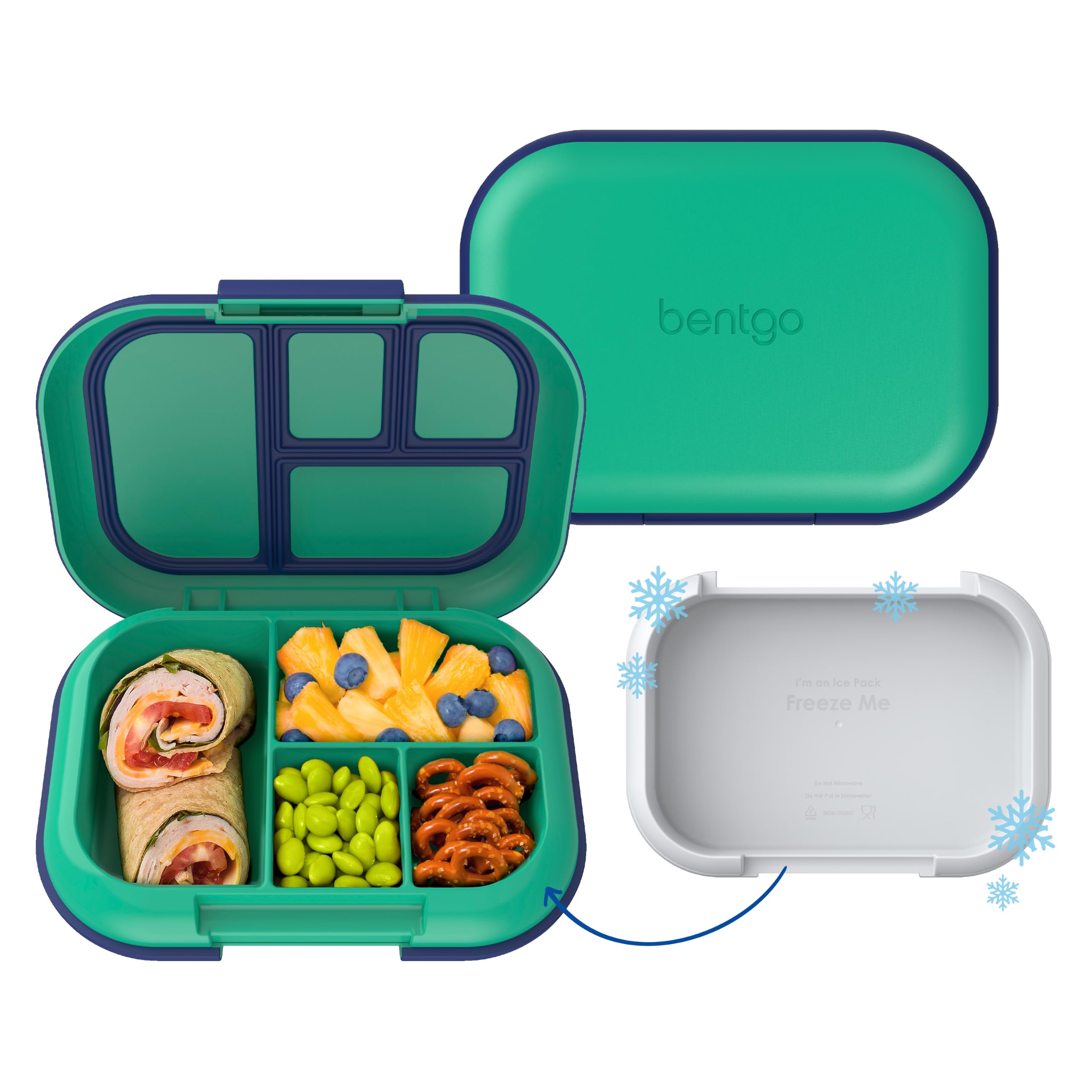
Bentgo Chill Kids Lunch Box
Best for: Everyday leak-resistant lunches with a built-in ice pack option
A kids bento with a removable ice pack that nests under the tray, a 4-compartment layout sized for younger appetites, and a latch designed for little hands. Confirm current colors and care notes on Amazon.
- Removable ice pack that nests under the tray
- Leak-resistant design for saucier sides
- 4-compartment tray; maker lists ages about 3–7
- Removable tray; check listing for dishwasher vs hand-wash parts
Keep in mind: Fixed compartment sizes mean you pack around the wells.
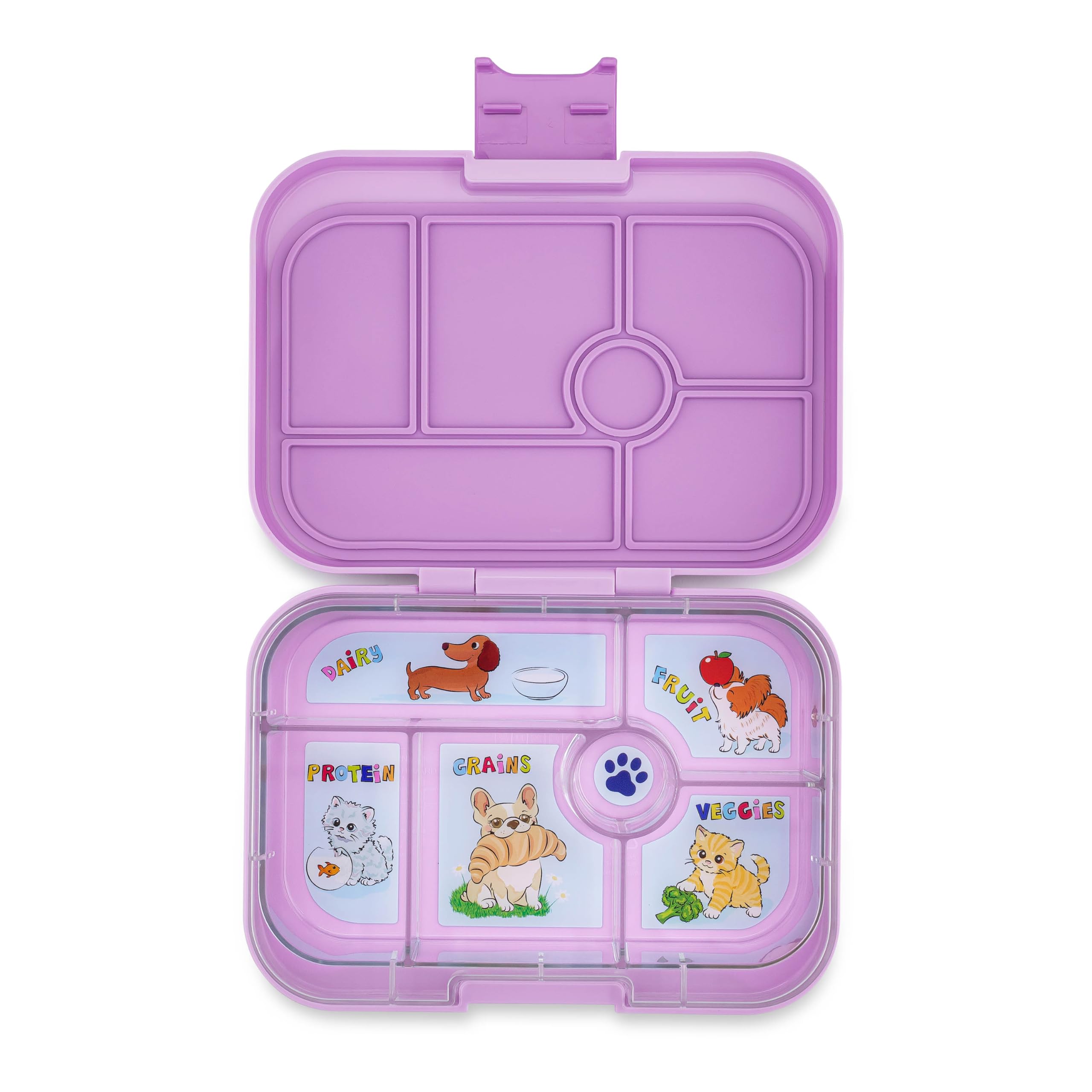
Yumbox Original Leakproof Bento
Best for: Little hands who open lunch themselves
A single-latch leakproof tray with portion-guided sections so a new kindergartner can open it and see where each food goes. Confirm tray layout and colors on the live listing.
- Single leakproof lid seals the tray
- One-latch open and close
- Illustrated portion sections for variety packing
- Compact, backpack-friendly footprint
Keep in mind: Fixed portions can run small for bigger appetites.
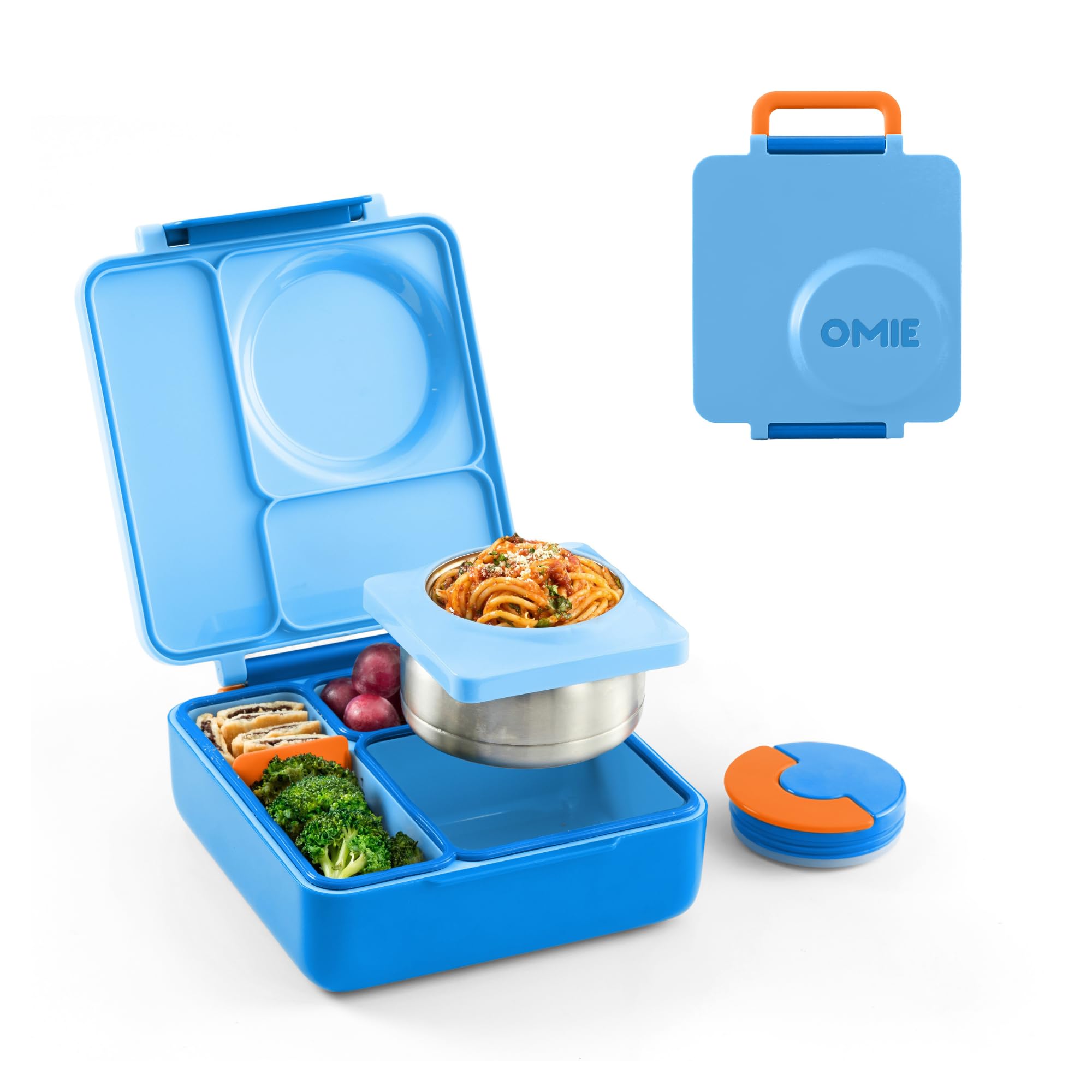
OmieBox Bento Box for Kids
Best for: Packing soup or warm leftovers beside cold sides
A bento with a built-in insulated food jar so you can send warm food and cold food in one unit. OmieLife care guidance says hand-wash and dry seals daily — not a set-and-forget dishwasher item.
- Built-in insulated thermos for hot food
- Cold compartments alongside the warm jar
- Stacks into one carry unit with a kid-sized handle
- Replacement seals/parts available from the maker
Keep in mind: Bulkier than a flat bento, with more parts to wash and dry by hand.
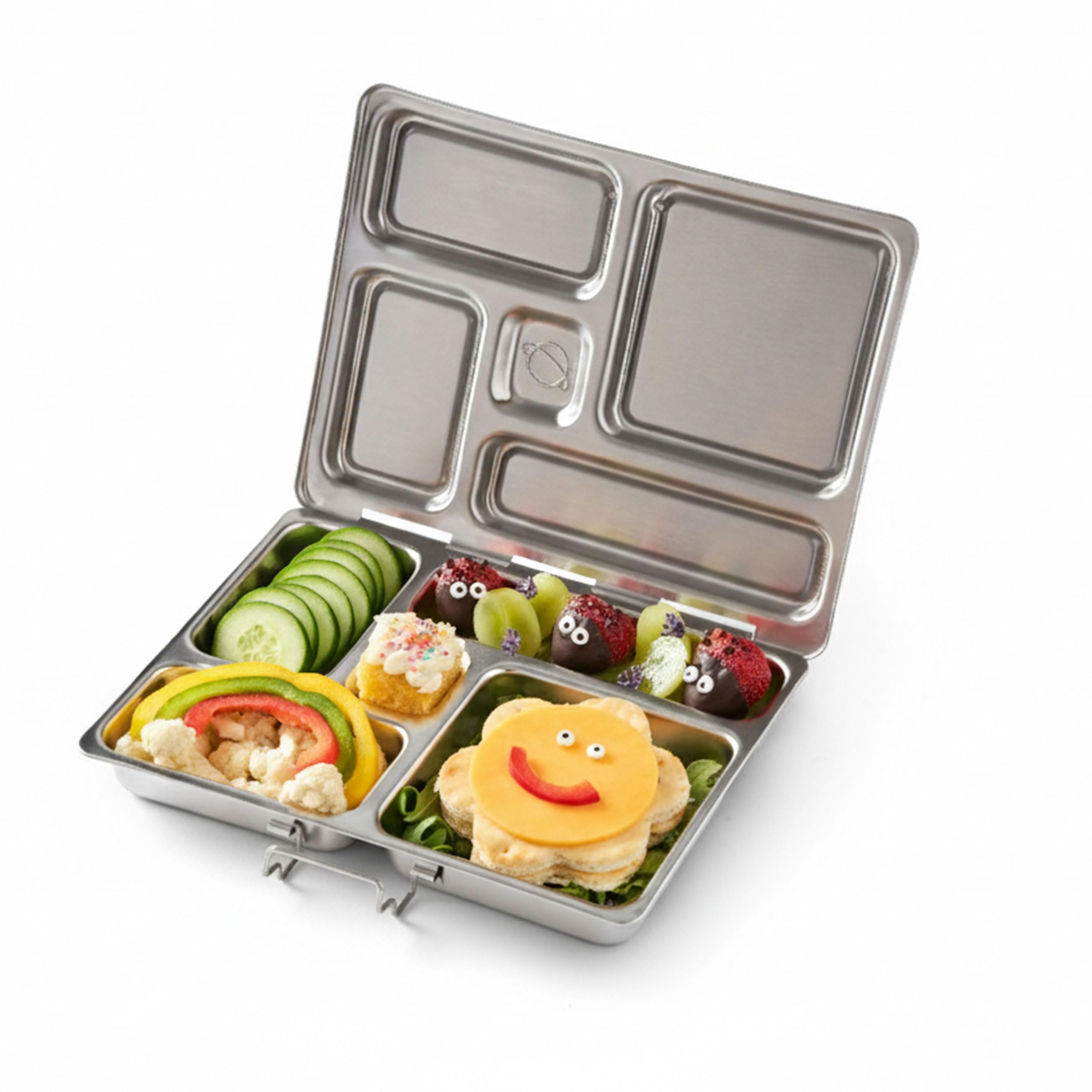
PlanetBox Rover Stainless Lunchbox
Best for: A stainless multi-compartment tray built to last
PlanetBox Rover-style stainless lunchbox body with multiple compartments and no plastic on the food surface. Amazon lists this item as a replacement body compatible with Rover accessories — confirm whether the offer is a full set or tray-only before you buy.
- Durable stainless-steel construction
- Multi-compartment tray for variety packing
- Dishwasher-safe tray per PlanetBox product pages
- Works with Rover dippers/bags/magnets when you own or add them
Keep in mind: Not sealed for wet or saucy foods without separate dip cups; verify set vs replacement on the listing.
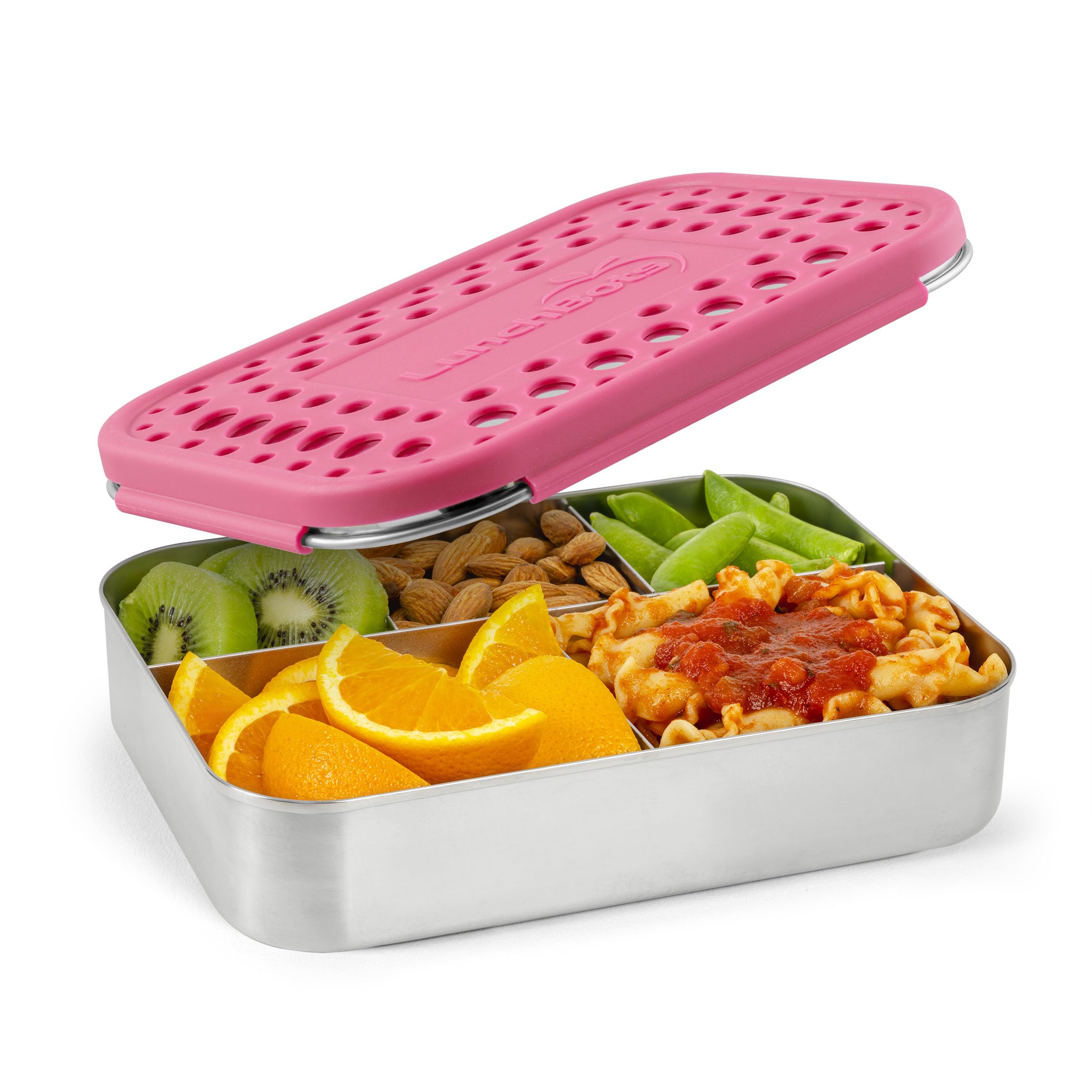
LunchBots Large Cinco Stainless
Best for: Plastic-free simplicity for dry foods
A five-section stainless container with a stainless lid. LunchBots notes the lids and dividers are not watertight — pack dry foods or use separate dip containers for wet sides.
- 18/8 stainless steel food contact surfaces
- Five compartments for variety
- Dishwasher-safe
- Optional snap-on Dots cover on some colorways
Keep in mind: Not leakproof between sections — skip runny foods unless you add sealed cups.
As an Amazon Associate I earn from qualifying purchases. Mom's Magazine may earn a commission when you buy through links on this page, at no extra cost to you. Learn more.
Frequently Asked Questions
What is the most important feature in a kindergarten lunch box?
Whether your child can open and close it alone. Lunch periods are short and adults are busy, so a hard latch means a skipped meal. Practice at home before the first day.
Are bento boxes better than regular lunch boxes for kindergarten?
It depends on how your child eats. Bentos separate foods and cut baggies, but portions are fixed. A classic single-compartment box is roomier for wraps. Either can work if the latch is kid-friendly.
Do I need an insulated lunch bag if I already bought a bento?
If you pack perishable foods and the school has no fridge, yes. USDA FSIS recommends insulated bags plus at least two cold sources for perishable bag lunches. Many bentos are not a substitute for that cold chain.
How do I keep packed lunch food safe until noon?
Follow USDA FSIS bag-lunch guidance: keep perishables cold with an insulated bag and at least two cold sources placed above and below the food; keep hot foods in a preheated insulated container; discard leftovers that sat in the Danger Zone too long. Read the FSIS pages linked in Sources.
What size lunch box should I get for a five-year-old?
Match real appetite and backpack space. Too big invites waste and weight; too small means a hungry afternoon. Pack what they finish at home, then adjust after the first week of uneaten returns.
Which lunch boxes on this page are leak-resistant?
Bentgo Chill Kids and Yumbox Original are positioned as leak-resistant/leakproof tray systems for wetter sides. OmieBox uses seals plus a thermos jar for liquids. PlanetBox Rover and LunchBots Cinco stainless trays are generally for drier foods unless you add separate dip cups — confirm each listing.
Is OmieBox dishwasher-safe?
OmieLife's care guidance says to hand-wash OmieBox and to remove the lid seal and thermos gasket for cleaning and full drying. Do not assume dishwasher-safe from the word bento alone.
Why does the PlanetBox Rover Amazon link look like a replacement body?
Confirm on the product page whether you are buying a full set (bag, dippers, magnets) or only the tray before you check out.
How long is a typical kindergarten lunch period?
Many schools run roughly 15–25 minutes for the whole class to sit, open food, eat, and clean up — confirm your school's schedule. Pack for that clock: kid-openable latches and familiar foods beat elaborate setups.
How should we practice opening the lunch box before school?
Run a latch-practice week at home: empty open/close first, then a mock lunch with the real bag and cold packs, then one timed run matching lunch length. If the latch still needs adult hands after a week, switch boxes.
What does USDA FSIS say about ice packs in school lunches?
FSIS recommends insulated soft-sided bags and at least two cold sources with perishable food — for example two frozen gel packs (not smaller than 5x3 inches each) or a gel pack plus a frozen juice box or water bottle — placed above and below perishables. See the FSIS Keeping Bag Lunches Safe page linked in Sources.
Can a frozen water bottle replace ice packs?
FSIS allows combining a frozen gel pack with a frozen juice box or frozen bottle of water as cold sources. A frozen water bottle can help if it fits without crushing food and still leaves adequate cold contact with perishables — it is not a reason to skip insulation.
How do I label lunch boxes for allergy-aware classrooms?
Follow your school's written policy. At minimum, put your child's name on the box and bag. Do not invent medical advice for other children; if your child has a diagnosed allergy, use the clinician and school care plan.
Why does my lunch box smell musty by fall?
Usually damp seals closed overnight or a wet insulated bag in a cubby. Wash, remove gaskets when the maker directs, and air-dry fully open. Persistent mildew smell after cleaning means replace the seal or the box.
Sources & Further Reading
- Keeping "Bag" Lunches Safe — USDA Food Safety and Inspection Service (reviewed 2026-09-23)
- USDA Reminds Families to Pack Food Safety with Back-to-School Lunches — U.S. Department of Agriculture (reviewed 2026-09-23)
- Get An A+ in Lunchbox Back-to-School Food Safety — U.S. Department of Agriculture (reviewed 2026-09-23)
- How to Keep Your OmieBox in Tip-Top Shape — OmieLife (reviewed 2026-09-23)
Related Guides
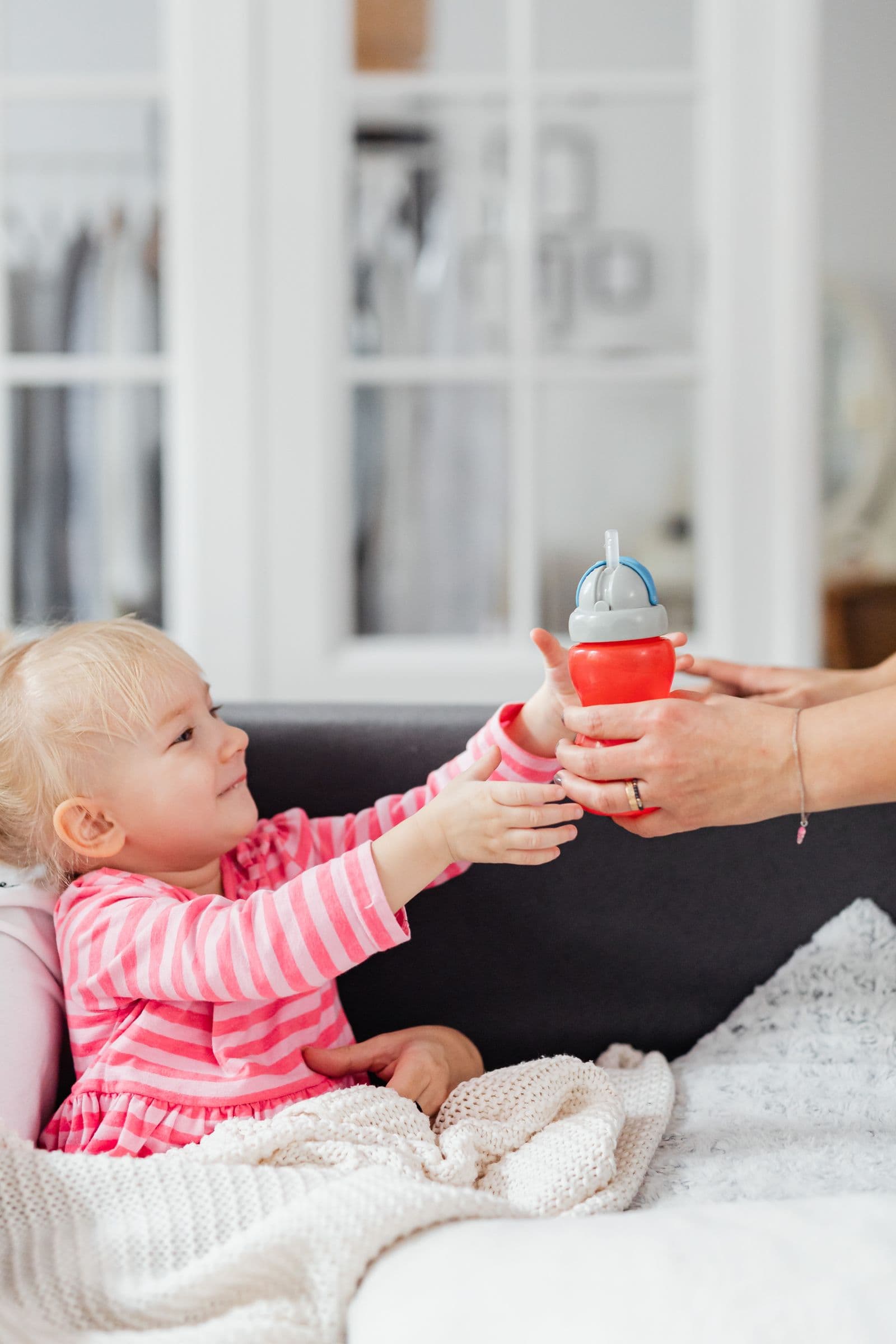
Best Sippy Cups (2026): Spoutless 360, Straw & Open-Cup Transition
Best sippy cups by drinking mechanism — spoutless 360, weighted straw, stainless, open-cup trainers — plus a CDC/AAP age-band transition plan (6 months to ~2 years), spill/mold/travel pitfalls, and AAPD tooth-decay context. Four Amazon picks.
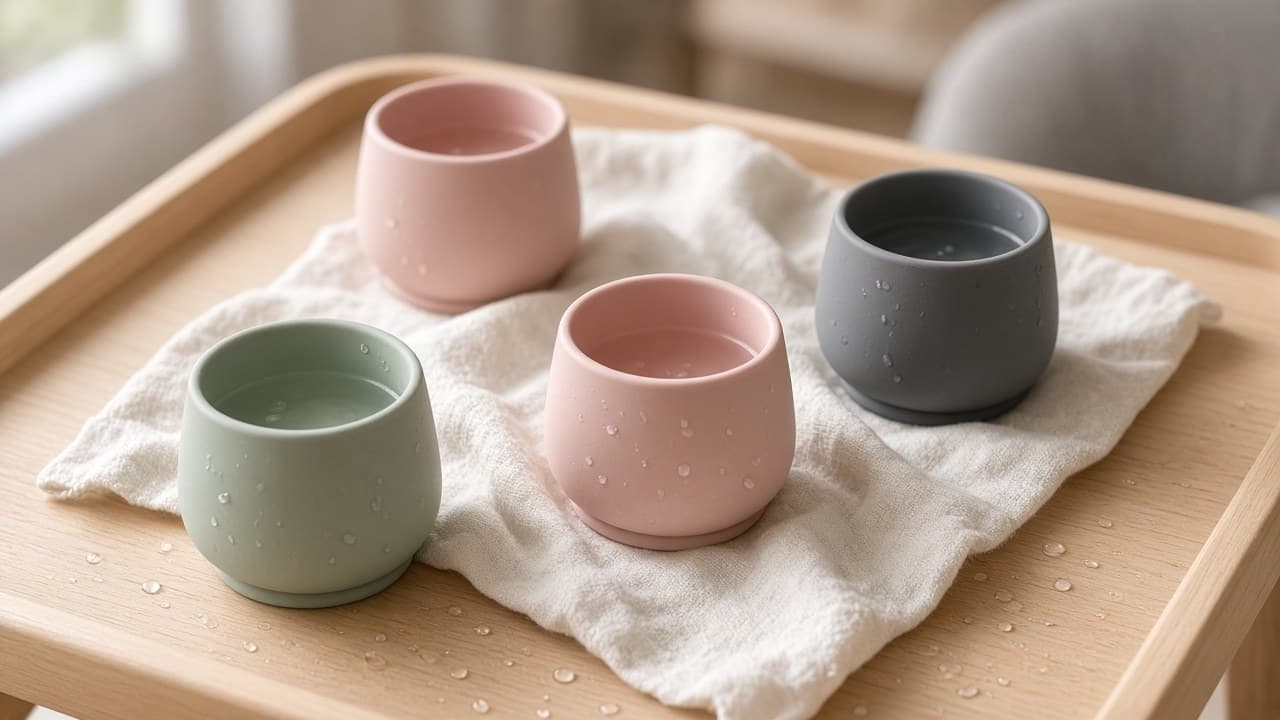
Best Open Cups for Babies and 6-Month-Olds (2026 Buying Guide)
Why open-cup and straw skills matter around 6 months with solids, how they differ from valved sippies, and four researched picks — ezpz Tiny Cup, ezpz Mini Cup + Straw, Munchkin C'est Silicone in Coral/Pink, and a squeeze straw trainer — with CDC and AAP sources.
Best First Baby Foods & Best First Foods for Baby (CDC and AAP Guide)
Best first baby foods and best first foods for baby, in plain CDC and AAP terms: iron-rich starters around 6 months, one food at a time, allergen timing, first-feeding setup (bibs, spoons, cups), and what not to give. Editorially reviewed general information, not medical advice — not a ranked jar list.
Best Water Bottles for Kids (2026): Preschool, Lunch Bag & Sports
Best water bottle for kids by job — preschool carry, school lunch bag, sports bag, and older-kid dual spout — plus leak tests, cleaning to stop straw mold, size by age, and CDC/AAP water guidance.
Best Insulated Lunch Bags for Kids (2026 School Lunch Guide)
Best insulated lunch bags for kids for school: freezable-wall vs thick soft insulation vs fitted brand bags vs kids hard-sided coolers, USDA FSIS and CDC cold-safety packing framework, and five real Amazon options.
School Lunches That Don't Need Refrigeration: No-Fridge Ideas That Stay Food-Safe
School lunches that don't need refrigeration: shelf-stable protein, fruit and veggie ideas, how to pack a thermos so hot food stays safe, and the USDA 40°F–140°F rule for anything perishable.
Best Backpacks for Elementary School
How to choose a well-fitting, durable elementary-school backpack, plus options to compare.
Back-to-School Checklist by Grade
A practical, grade-by-grade back-to-school checklist covering supplies, routines, and paperwork.
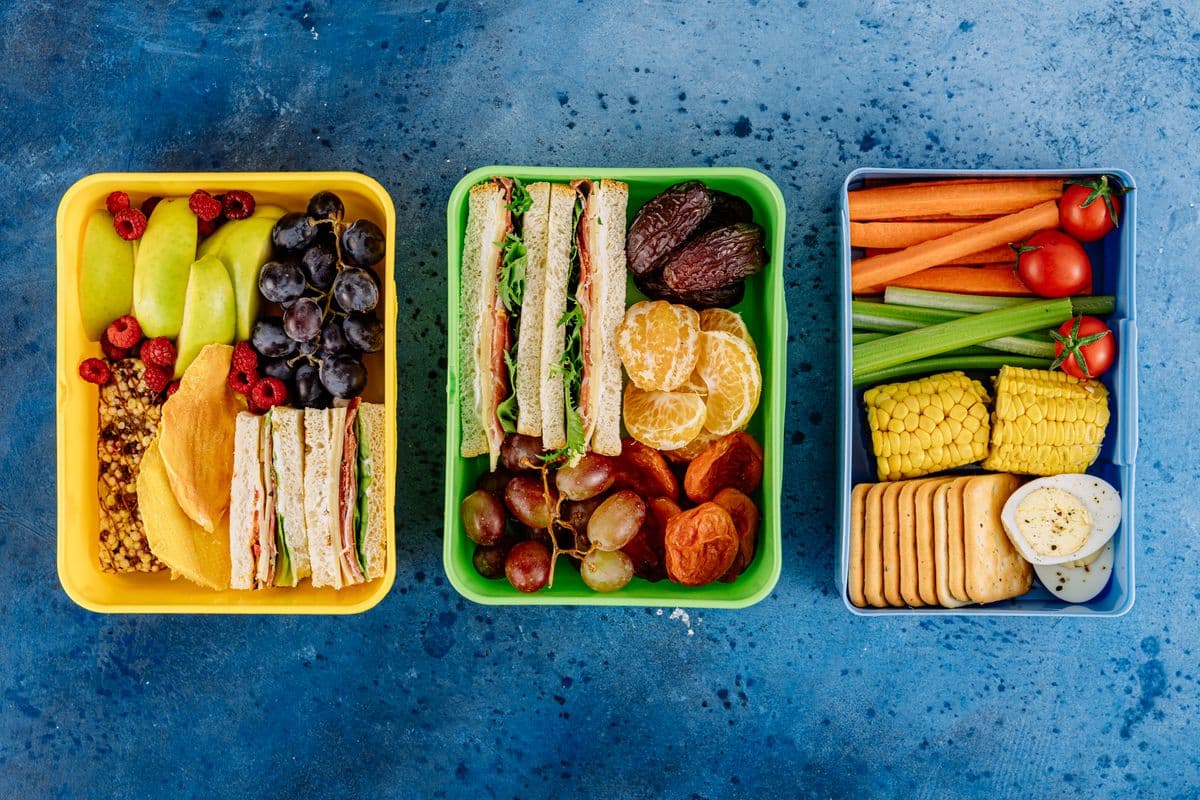
Best Toddler Snack Containers of 2026
Spill-proof snack cups, silicone snack bags, and stacking snack containers compared by lid mechanism — plus lunchbox packing, daycare snack rules (CFOC/HHS piece size and grape quartering), and how snack cups pair with bento boxes and insulated lunch bags.
Mom's Magazine Editorial Team
Editorial Team
The Mom's Magazine editorial team researches and writes practical, plainly-sourced guidance for parents and families. Guides are reviewed for accuracy and updated as recommendations change. Where a topic calls for professional expertise, we cite reputable organizations and, for health topics, add a qualified reviewer before publishing.
Newsletter
Get the Weekly Mom List
One short email a week: the most useful guides, activities, and picks for your family. No spam, unsubscribe anytime.