Activities
Activities for 3-Year-Olds
Activities for 3-year-olds that match just-turned-three play: pretend scenes, simple crafts, early counting, helper jobs, and one outdoor outing. Based on CDC 3-year milestones and AAP pretend-play and toy-safety guidance.
As an Amazon Associate I earn from qualifying purchases.Some links on this page are affiliate links. If you buy through them, Mom's Magazine may earn a small commission at no extra cost to you. It never changes which products we recommend. How we recommend products.
Activities for 3-year-olds work best when they mix pretend play, a small craft or activity box, early counting and matching, helper jobs around a meal, and some outdoor play the child chooses. The CDC 3-year milestone page describes things most children this age (about 75% or more) can do: join other children, have a short back-and-forth conversation, draw a circle after you show how, string large beads or macaroni, put on some clothes, and use a fork. That same page suggests talking about feelings, keeping a few simple rules, asking what is happening in a picture, playing counting games, giving two- or three-step instructions, and keeping an activity box with paper, crayons, and coloring books. The AAP pretend-play page describes dress-up, symbolic props, and rehearsing real-life places. This page is the mixed indoor-and-out list for a just-turned-three child. It is not the 2-year page, not the toddler indoor page, not the rainy-day indoor list for mixed ages, not the full outdoor preschooler yard guide, and not the screen-free habit page.
Our top pick
MAGNA-TILES Classic 32-Piece Magnetic Construction Set
Best for: A 3-year-old who can now build a house or bus and then play a story inside it
Quick picks
| Product | Best for | |
|---|---|---|
| MAGNA-TILES Classic 32-Piece Magnetic Construction Set | A 3-year-old who can now build a house or bus and then play a story inside it | Check price on Amazon |
| Melissa & Doug Deluxe Wooden Lacing Beads | Sitting together to practice the CDC 3-year skill of stringing large beads or macaroni | Check price on Amazon |
| Play-Doh Kitchen Creations Noodle Party Playset | Table-level kitchen pretend plus the CDC 3-year playdough hand-muscle tip | Check price on Amazon |
| SEREED Toddler Balance Bike | The one outdoor ride-on on this page, on a sidewalk, with a helmet, then a handoff to the outdoor preschooler article | Check price on Amazon |
A just-turned-three child is not a bigger two-year-old and not yet a kindergarten planner. They can hold a short pretend scene, notice another child and try to join, follow two or three steps when you keep the words short, and start to care whether the noodle they rolled looks like lunch. That mix is what this page is for. If you want dumping, filling, and one-step toddler indoor play, use indoor-activities-for-toddlers. If the child is still two, use activities-for-2-year-olds. If the weather is wet and you need a mixed-age indoor list, use rainy-day-activities-for-kids. If you want the full yard, sun, water, chalk, bubbles, and playground page, use outdoor-activities-for-preschoolers. If the job is keeping screens off on purpose, use screen-free-activities-for-kids. This guide covers activities for 3-year-olds and activities for 3.
If you are shopping for a present instead of setting up play you already have at home, best gifts for 3-year-olds is the buying guide for this age: pretend play, building, a first board game, art, screen-free audio, and an outdoor kitchen, from manufacturer listing details checked October 22, 2026.
Editorially reviewed — not medical advice
Mom's Magazine editorial staff wrote this page using the CDC and AAP pages named in the sources list. It is not medically reviewed. It is not a milestone screener, not a diagnosis, and not a substitute for your child's clinician. If your child is not meeting milestones, has lost skills they used to have, or you are worried, the CDC 3-year page says to talk with the doctor, ask about developmental screening, and look at early-intervention help through the CDC FindEI page.
What actually changes at 3
The CDC page titled "3 Year Milestones," last reviewed May 15, 2026, is the age map this article uses. CDC says milestones are things most children (75% or more) can do by a certain age. The page is a checkpoint, not a test you score at the kitchen table. Social and emotional examples on that page include calming down within 10 minutes after you leave, and noticing other children and joining them to play. Language examples include having at least two back-and-forth exchanges, asking who, what, where, or why, talking about an action in a picture book, saying a first name when asked, and being understood most of the time. Cognitive examples include drawing a circle when shown how and avoiding a hot object when you warn them. Movement examples include stringing items together such as large beads or macaroni, putting on some clothes independently, and using a fork.
The CDC preschool positive-parenting page for ages 3 to 5, last reviewed February 20, 2026 and opened the same day, adds everyday pictures of this stage: helping to dress, recalling part of a story, singing a song, playing with other children, riding a tricycle, and using safety scissors. They are also why we do not treat a 3-year-old as a toddler who only dumps bins.
CDC 3-year parenting tips from that milestone page are concrete enough to build a week around: let your child solve a small problem with your support, talk about their emotions, keep a few simple and clear rules, read and ask what is happening and what happens next, play counting games with body parts or stairs, speak in longer sentences and expand a short phrase (their example is turning "need nana" into "I want a banana"), help with meals such as washing fruit or stirring, give instructions with two or three steps, sing songs and rhymes, keep an activity box with paper, crayons, and coloring books, play with other children, use playdough to squish, press, pinch, and roll balls so hand muscles get work, offer simple food choices, play opposite and matching games, play outside and let them choose what to do and how, join in and follow their lead, role-play new places, and help them tell you their name and age.
What CDC doesn't put a number on
The CDC pages do not publish a 3-year-old attention-span minute count. We are not printing 8 minutes, 15 minutes, or any other kitchen-timer figure as if CDC wrote it. End a craft when the child is done. CDC physical-activity guidance for ages 3 through 5, last reviewed December 4, 2025, says preschool-aged children should be physically active throughout the day and that caregivers should encourage active play such as jumping or riding a tricycle. The 60-minutes-or-more target on that same page is written for ages 6 through 17. Sleep is also not a play quota: the CDC preschool page lists 10 to 13 hours per 24 hours including naps for ages 3 to 5. The CDC toddler page for ages 2 to 3 lists 11 to 14 hours. A child who just turned 3 sits near that boundary; use the clinician you already have if sleep is the question.
Pretend play is the main event at 3
The AAP page "The Power of Pretend Play" on HealthyChildren.org, updated March 24, 2023, is the indoor engine this age actually wants. AAP describes dress-up and props, letting children take the reins and world-build, using objects as something else (their examples include a hairbrush as a microphone and toilet-paper rolls as binoculars), and rehearsing real-life places such as a doctor visit or the first day of school. AAP ties that play to language, symbolic thinking, and social-emotional practice including turn-taking. That is a different job than the rainy-day page, which is a wet-day indoor list for mixed ages, and a different job than the 2-year page, which is still mostly dumping, filling, and one-step cause and effect.
Set a small stage and then stop directing. A sheet over two chairs is a clinic. A laundry basket is a bus. Three plastic plates are a noodle shop. Hand over one prop and wait. If they assign you a role, take it. If they change the story halfway through, follow. AAP is explicit that the child should take the reins. Your job is to keep the space safe and to add a sentence of language when it helps, the same way CDC suggests expanding a short phrase into a longer one.
Dress-up and leftover-box props
You do not need a themed costume set. A leftover box with a scarf, a leftover gift bag, a clean wooden spoon, a notepad, and a toy phone is enough for a store, a kitchen, or a vet clinic. AAP's point about symbolic objects is the useful one: the hairbrush can be a microphone today and a doctor tool tomorrow. Keep anything with a button or lithium coin battery out of this box. Keep balloons out of it. Keep anything that can squeeze into a mouth and block an airway out of it. Those limits come from the AAP toy-safety and choking pages named below, not from a ranking of dress-up kits.
Rehearse a real place before you go
AAP names doctor visits and the first day of school as pretend-play rehearsals. That is a 3-year-old use of play, not a toddler dump-and-fill game. Before a haircut, a new classroom visit, or a checkup, play the scene once with stuffed animals. Let the child be the adult. CDC's 3-year tips also include role-playing new places and helping the child say their name and age, which fits the same rehearsal. If potty learning is happening in your house, keep the how-to on potty-training-readiness-and-how-to-start. A doll toilet can be pretend rehearsal. This page is not a potty-training guide.
Join, then follow their lead
CDC's 3-year outdoor tip is also the right indoor stance: play with them, let them choose what to do and how to do it, and follow their lead. If you set up a store and they turn it into a fire station, you are not failing the activity. You are doing the activity.
An activity box and crafts that stay simple
CDC's 3-year tips include keeping an activity box with paper, crayons, and coloring books, using playdough to build hand muscles, and showing a circle so the child can try to draw one. That is the craft lane on this page. It is not the rainy-day indoor list, and it is not a Pinterest contest. Process beats a display-shelf result. If the drawing is a scribble with one proud circle in the corner, that matches the milestone page we actually opened.
Stock the box with paper, crayons, a few washable markers, a glue stick, leftover paper scraps, and safety scissors if you are sitting there. The CDC preschool page lists safety scissors as an example of what children this stage may use. Sit with the first cuts. Keep the good fabric shears in another drawer. Offer one prompt, not a 12-step craft kit: "Draw a circle and tell me who lives in it," or "Cut the leftover mail into tickets for the bus."
- Circle practice: you draw one slowly, they try. CDC names this on the 3-year milestone list.
- Picture talk: read a page and ask what is happening and what happens next, which is a CDC 3-year reading tip, not a worksheet.
- Playdough tools: a dull plastic knife, a cup for circles, and clean hands. CDC names squish, press, pinch, and roll.
- Color-and-tell: they color, then they tell you the story. You write one sentence they said on the page if they want it there.
- Sticker-and-sort: leftover stickers sorted by color or shape, then stuck on a paper bus or clinic. Matching is a CDC 3-year tip.
Skip glass beads, tiny seed beads, hobby knives, essential oils, and anything the AAP toy-safety page flags as a hobby or chemistry set under age 12. If a craft uses small parts, it is not a 3-year-old independent station. It is a sit-together station.
Playdough as kitchen pretend, not as a ranked toy
CDC already put playdough on the 3-year tip list for hand muscles. AAP already put kitchen and restaurant scenes inside pretend play. The Play-Doh Kitchen Creations Noodle Party playset on this page sits at that overlap. AAP's toy-safety page, updated December 19, 2024, tells parents to look for toys labeled nontoxic. That is why the word on the listing matters. It is not a score.
Use the set as a pretend noodle shop, not as a 40-minute product demo. Put out two plates. Take an order. Roll, press, and pinch. When the child is done, lids go on so the dough does not dry out. The accessory pieces are small. Stay at the table. If a younger sibling is in the room, this is not a floor-scatter toy. It is already on the page, so we are telling you how a 3-year-old can use it.
Early counting, matching, and two- or three-step language
This is the other thing that is new at 3 and is not the job of the 2-year page. CDC's 3-year tips include counting games (body parts, stairs), opposite games, matching games, two- or three-step instructions, and asking who, what, where, or why. None of that has to look like a workbook. Count the stairs you already climb. Match two socks from the laundry pile. Give a three-step job you can see: "Please get your cup, put it on the table, and sit down." If they do two of the three, you finish the third together and try again later. That is coaching, not a failed quiz.
- Stair count: one number per step, then stop at the landing. CDC names stairs as a counting game.
- Body-part count: "How many elbows?" then "How many knees?" Keep it a game, not a drill.
- Opposite walk: big step, little step, loud hello, quiet hello. CDC names opposite games.
- Picture questions: who is in the picture, what are they doing, where are they, why did they run. CDC names those question words.
- Name and age: practice saying both, which CDC lists as a 3-year tip, especially before a new classroom or clinic.
- Two- and three-step tidy: toys in the bin, book on the shelf, then wash hands. Short words. One job at a time if three is too many today.
The CDC preschool page also says to use complete sentences and grown-up words, and to offer a limited number of simple choices. That is the tone for these games. "Red cup or blue cup" is a 3-year-old choice. A quiz with eight options is not. If they want the same matching game four days in a row, that is still the game. Repetition is how a 3-year-old confirms they can do it.
Lacing beads and the stringing milestone
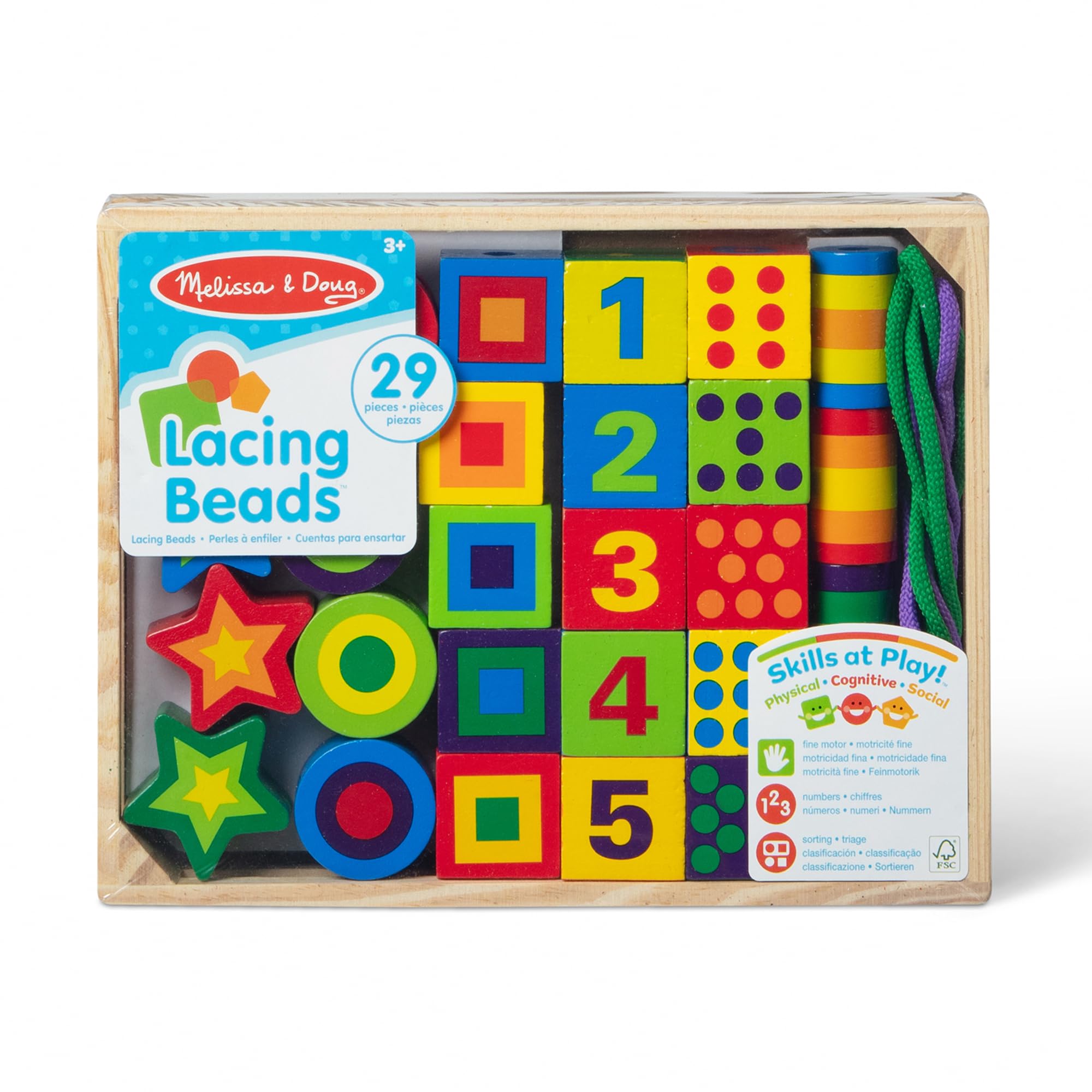
CDC's 3-year movement list includes stringing items together, like large beads or macaroni. The set includes 27 beads, 2 laces, and a storage tray (29 pieces), labeled ages 3+. Large dry pasta on a leftover lace is the no-purchase version of the same milestone. Either way, sit there. A bead that is large for a 3-year-old can still be a problem if a younger sibling mouths it. AAP's choking page, updated February 27, 2026, lists pieces of toys and small balls among the items that cause the most choking deaths, and it flags older siblings handing things to younger children.
Make it a pretend necklace shop or a color-sort, not a race. One lace, a few beads, and a bowl to hold the extras is enough. When you are done, the beads go back in the tray and the tray goes up. This one was already here and it maps to a milestone.
Building tiles for a story, not a STEM score
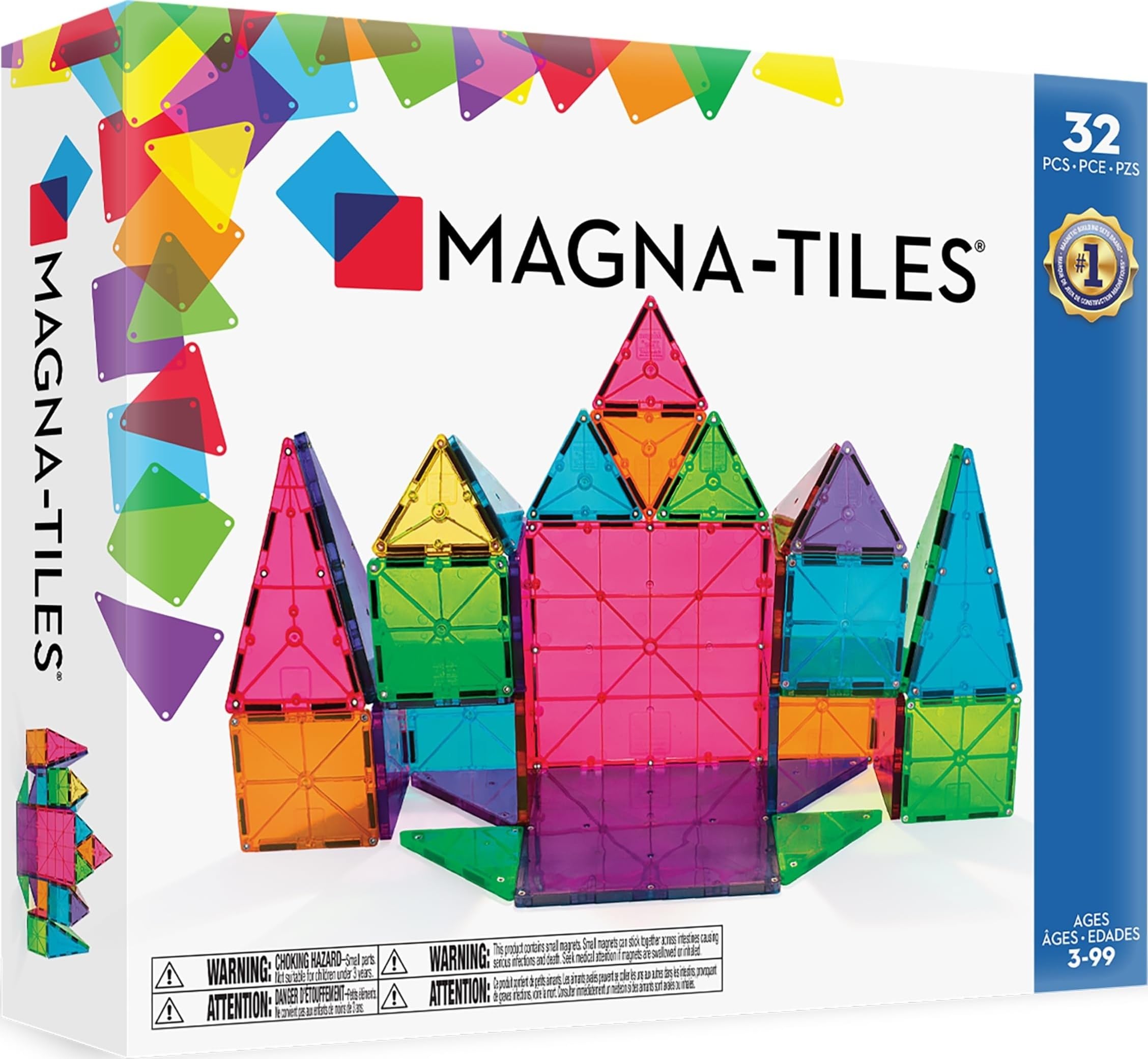
Magnetic tiles are on this page as the Magna-Tiles Classic 32-piece set. Here the tiles are for a 3-year-old who can now build a house and then put a stuffed animal inside it. The 32-piece box is a starter. Ambitious builders run out of pieces. Follow the age label on the box you have.
Build a clinic, a bus, or a noodle shop and then play in it. That is pretend plus construction, which is the 3-year mix.
Other children, feelings words, and a few rules
CDC's 3-year social picture is specific: the child notices other children and joins them to play, and they can calm down within 10 minutes after you leave. The same page tells you to talk about emotions and keep a few simple, clear rules. The preschool page adds helping a child solve a problem when they are upset. That is the social lane on this page. It is not a classroom-management curriculum.
Playdates at this age are short and supervised. One friend, one room, one shared bin is enough. Narrate the feeling you see: "You wanted the red plate. You are mad. We can wait or we can find another plate." That is CDC's feelings-talk tip in ordinary language. A few rules you can actually enforce beat a poster of twelve rules. "We do not throw the beads. We take turns with the bike helmet. We walk inside." When a rule is broken, CDC preschool language is clear, consistent discipline, not a lecture.
If there is no second child around today, stuffed animals still work for turn-taking. Pretend the bear is waiting for the noodle shop. That is AAP social-emotional practice without a playdate on the calendar.
Helper jobs: clothes, meals, and two-step chores
CDC's 3-year movement list includes putting on some clothes and using a fork. The tips on the same page include helping with meals (washing fruit or vegetables, stirring) and two- or three-step instructions. The preschool page adds simple chores and helping to dress. That is real 3-year-old activity, not filler. It also happens on days you do not want a craft explosion.
- Clothes: they put on the shirt or the shoes they can manage. You do the rest. CDC says "some clothes," not a full independent dressing exam.
- Fork practice at a meal you are already serving. Sit with them. Food is not a toy bin.
- Wash the berries or stir the batter while you stand there. CDC names both.
- A two-step clean-up you can see: napkin in the bin, cup on the counter.
- A simple choice CDC preschool language allows: apple slices or banana, blue cup or yellow cup.
These jobs double as language. You expand "more nana" into "You want more banana," the way CDC models it. You are not running a chore chart with stickers unless that already works in your house. We are not selling a chore system.
A week you can scan, not a schedule you owe
This table is a mix of the lanes above. It is not a CDC timetable. Swap days. Repeat a day. Skip a day. If you only do pretend play and a walk, you still used this page.
| Day | Indoor 3-year mix | One outdoor or helper beat |
|---|---|---|
| Mon | Leftover-box store or clinic; you take the role they assign | Walk the stairs and count them |
| Tue | Activity-box circle drawing and picture talk | Wash fruit for a snack they chose |
| Wed | Playdough noodle shop at the table | Outside play they choose; you follow |
| Thu | Lacing beads or large pasta on a lace, then tray away | Put on some clothes before you help |
| Fri | Magnetic tiles become a bus or a house, then play inside it | Opposite-step walk to the mailbox |
| Sat | One friend or stuffed-animal turn-taking in one room | Balance bike on a sidewalk with a helmet, or a walk if there is no bike |
| Sun | Read and ask what happens next; matching socks from laundry | Simple two-step tidy after a meal |
One outdoor note, then the yard page
CDC's 3-year tips say to play outside, let the child choose what to do and how, and join in and follow their lead. CDC physical-activity guidance for ages 3 through 5 says to keep them physically active throughout the day and to encourage active play such as jumping or riding a tricycle. That is the outdoor claim this page will make. The full yard, sun, water, chalk, bubbles, garden, playground-check, and picnic page is outdoor-activities-for-preschoolers. We are not copying that article here.
The SEREED toddler balance bike on this page is the one outdoor tool we keep. CDC preschool safety language says to stay out of traffic, not to play in the street or run after balls, to ride a tricycle on the sidewalk, and to wear a helmet. We are applying that sidewalk-and-helmet line to a no-pedal balance bike because the listing itself is a ride-on for this age band. For sun, playground, and deeper yard safety, see our outdoor activities for preschoolers guide.
A helmet that fits, a flat sidewalk or path, and an adult who is actually watching are the conditions. CDC preschool is blunt: watch children at all times, especially when they are outside, check playground equipment for loose parts and sharp edges, and watch children in or around any water, including kiddie pools. CDC drowning prevention, last reviewed September 29, 2025, says more children ages 1 to 4 die from drowning than from any other cause, that it can happen in seconds and is often silent, and that a designated adult should supervise without phone, reading, or alcohol. Lessons and air-filled toys do not replace that adult. If water is part of the day, that is a watch-the-water day, not a chat-on-the-bench day. Then go back to the outdoor page for the rest of the yard.
This is not the outdoor preschooler article
No scavenger-hunt script, no chalk-obstacle course, no bubble recipe, no garden-bed how-to, and no water-table setup lives here. Those belong to outdoor-activities-for-preschoolers. This page names outside play, a helmet-and-sidewalk ride, and the CDC watch-at-all-times line, then hands the rest over.
Safety at 3: more skill, same supervision
A 3-year-old can follow a warning about a hot object, which CDC lists as a cognitive milestone, and they can put on some clothes. They are still the age band AAP's choking page treats as high risk. That page, updated February 27, 2026, says balloons, balls, marbles, pieces of toys, and small round foods cause the most choking deaths. Balloons remain a risk up through age 8. Most choking deaths are in children under 5. Household items on that page include coins, marbles, toys with small parts, toys that can squeeze into the mouth, small balls, pen and marker caps, and button or lithium batteries. Follow the age recommendation on the toy. Check under furniture and cushions. Watch what an older sibling hands down.
AAP's toy-safety page, updated December 19, 2024, says each year thousands of children are injured by toys and that most of those injuries are minor cuts, scrapes, and bruises, while some toys can cause serious injury or death. We are quoting that wording. AAP's practical list from the page: read the label, think large (parts larger than a mouth), skip shooting toys, skip loud toys, choose sturdy plastic, look for nontoxic, skip hobby and chemistry sets under 12, follow age recommendations because they reflect choking risk and the child's abilities, watch button and lithium coin batteries and high-powered magnets, and remove a recalled toy. AAP names CPSC as the recall agency. We can say that.
- Age label first. A 3+ bead set is not a 1-year-old toy, even if the 3-year-old is "good with small things."
- Think large. If it fits in a mouth, it is a sit-together material, not a floor-scatter material.
- Batteries and magnets are not loose-bin items. AAP flags both.
- No balloons as a 3-year-old party toy. AAP keeps that risk through age 8.
- Eat sitting down. The CDC toddler 2-to-3 page review date still says sit when eating; we are not treating a just-turned-three child as someone who can walk around with food.
- Check toys for loose or broken parts, which that same CDC toddler page also says.
- Water, including a kiddie pool or a bucket, gets a designated adult. CDC drowning language above.
- This page is not a first-aid class. AAP's choking page says to talk with the pediatrician and take certified CPR through a program such as the Red Cross or the American Heart Association.
Screens, in the words CDC actually used
The CDC 3-year milestone page says to limit screen time (TV, tablets, phones, and similar) to no more than 1 hour per day of a children's program with an adult present, and not to put any screens in the child's bedroom. The CDC preschool page says to keep television sets out of the bedroom, to set a limit of no more than 1 hour per day of quality programming at home, school, or afterschool care, and to make a family media-use plan.
If the job today is keeping screens off on purpose, that article is screen-free-activities-for-kids. This page's job is the 3-year mix when you do want an activity. An activity box, a pretend scene, a helper job, or a sidewalk ride can fill the hour you are not handing over a tablet. That is a handoff, not a second screen-free article.
The four tools on this page
Cards below are how a 3-year-old can use what is already here.
- MAGNA-TILES Classic 32-piece magnetic construction set, used here as a house, bus, or clinic a 3-year-old can play inside.
- Melissa & Doug Deluxe Wooden Lacing Beads, used here because CDC names stringing large beads or macaroni on the 3-year movement list.
- Play-Doh Kitchen Creations Noodle Party playset, used here as table-level kitchen pretend plus the playdough hand-muscle tip on the CDC 3-year page.
- SEREED toddler balance bike, used here as the one outdoor ride-on, with CDC preschool helmet and sidewalk language, then a handoff to the outdoor preschooler page.
Sources
Every health or safety claim above is tied to a cited source. The outdoor preschooler article is the yard deep-dive.
- CDC, 3 Year Milestones, https://www.cdc.gov/act-early/milestones/3-years.html, last reviewed May 15, 2026.
- CDC, Positive Parenting Tips for Preschoolers (3–5 years), https://www.cdc.gov/child-development/positive-parenting-tips/preschooler-3-5-years.html, last reviewed February 20, 2026.
- CDC, Child and Adolescent Guidelines for physical activity, https://www.cdc.gov/physical-activity-basics/guidelines/children.html, last reviewed December 4, 2025.
- CDC, Positive Parenting Tips for Toddlers (2–3 years), https://www.cdc.gov/child-development/positive-parenting-tips/toddlers-2-3-years.html, last reviewed January 29, 2026. Used only for sit-when-eating, check toys for broken parts, and the 2-to-3 sleep range at the age boundary.
- CDC, Drowning Prevention, https://www.cdc.gov/drowning/prevention/index.html, last reviewed September 29, 2025.
- AAP / HealthyChildren.org, The Power of Pretend Play, https://www.healthychildren.org/English/family-life/power-of-play/Pages/pretend-play-ways-children-can-exercise-their-imagination.aspx, updated March 24, 2023.
- AAP / HealthyChildren.org, How to Buy Safe Toys, https://www.healthychildren.org/English/safety-prevention/at-home/Pages/How-to-Buy-Safe-Toys.aspx, updated December 19, 2024.
- AAP / HealthyChildren.org, Choking Prevention, https://www.healthychildren.org/English/health-issues/injuries-emergencies/Pages/Choking-Prevention.aspx, updated February 27, 2026.
Our Recommendations
MAGNA-TILES Classic 32-Piece Magnetic Construction Set
Best for: A 3-year-old who can now build a house or bus and then play a story inside it
Key details: 32 tiles, squares and triangles, magnets along the edges, translucent colors. Use it as pretend-plus-building, not as a rainy-day ranking. Follow the age label on the box you have.
- Amazon listing: MAGNA-TILES Classic 32-Piece Magnetic Construction Set
- Build: 32 tiles, squares and triangles, magnets on the edges, translucent colors
- Fits a 3-year-old who can turn a stack into a clinic, bus, or house and then play in it
Keep in mind: 32 pieces is a starter box. Ambitious builders run out of tiles.
Melissa & Doug Deluxe Wooden Lacing Beads
Best for: Sitting together to practice the CDC 3-year skill of stringing large beads or macaroni
The set includes 27 wooden beads, 2 laces, and a storage tray (29 pieces), labeled ages 3+. That maps to the CDC 3-year movement milestone "strings items together, like large beads or macaroni." Large dry pasta on a leftover lace is the no-purchase version. Stay at the table. Beads go back in the tray when you are done.
- Amazon listing: Melissa & Doug Deluxe Wooden Lacing Beads, 27 beads, 2 laces, storage tray, ages 3+
- Matches a CDC 3-year milestone, not a homemade fine-motor score
- Tray makes it possible to put the set away instead of leaving beads on the floor
Keep in mind: Beads can still be a choking hazard, especially if a younger sibling is in the room. AAP's choking page flags toy pieces and older siblings handing things down. This is a sit-together activity.

Play-Doh Kitchen Creations Noodle Party Playset
Best for: Table-level kitchen pretend plus the CDC 3-year playdough hand-muscle tip
That sits on two pages: CDC's playdough tip (squish, press, pinch, roll) and AAP pretend play (kitchen and restaurant scenes). AAP toy safety also tells parents to look for a nontoxic label. Use it as a noodle shop with two plates, then close the cans.
- Amazon listing: Play-Doh Kitchen Creations Noodle Party Playset for Kids 3 Years and Up, 5 non-toxic colors
- Fits CDC playdough muscle work and AAP kitchen pretend on the same afternoon
- AAP toy-safety page tells parents to look for nontoxic labeling
Keep in mind: Lots of small accessory pieces, and dough dries out if cans stay open. Stay at the table. Not a floor-scatter toy when a younger sibling is around.

SEREED Toddler Balance Bike
Best for: The one outdoor ride-on on this page, on a sidewalk, with a helmet, then a handoff to the outdoor preschooler article
CDC preschool safety language says tricycles belong on the sidewalk and children should wear a helmet, stay out of traffic, and be watched at all times outside. We apply that same sidewalk-and-helmet line here. This is not a rainy-day toy and not a full yard guide.
- Amazon listing: SEREED no-pedal toddler balance bike, listed for 2-5 years, adjustable, white
- CDC preschool page: sidewalk, helmet, stay out of the street, watch at all times outside
- Outdoor-only tool on a page that is otherwise a mixed indoor-and-out 3-year list
Keep in mind: Needs a safe flat sidewalk or path and a helmet that fits. Useless indoors. Full yard, sun, water, and playground detail belongs on outdoor-activities-for-preschoolers, not here.
As an Amazon Associate I earn from qualifying purchases. Mom's Magazine may earn a commission when you buy through links on this page, at no extra cost to you. Learn more.
Frequently Asked Questions
What activities are best for a 3-year-old?
A mix, not a single category. This page's mix is pretend play (AAP dress-up, props, and rehearsing a real place), an activity box or playdough (CDC 3-year tips), early counting and matching, a helper job at a meal, and some outdoor play the child chooses. That is activities for 3-year-olds. It is not the 2-year list, not toddler indoor-only play, not the rainy-day indoor list, and not the full outdoor preschooler yard guide.
How long should a 3-year-old stay on one activity?
The CDC pages do not publish a 3-year-old attention-span minute count. End the craft or the bead lace when your child is done. CDC physical-activity guidance for ages 3 through 5 says to keep them physically active throughout the day. That is not a kitchen-timer number for a single table activity.
Is pretend play enough, or do we need worksheets?
AAP's pretend-play page treats dress-up, symbolic props, and rehearsing real-life places as the developmental work. CDC's 3-year tips add reading with "what is happening" questions, counting games, matching, and two- or three-step instructions. None of those require a worksheet. If a workbook is already something your child likes, it can sit beside the leftover-box clinic. It is not the requirement.
Are lacing beads safe for a 3-year-old?
The Melissa & Doug set on this page is labeled ages 3+ on its Amazon listing, and CDC names stringing large beads or macaroni as a 3-year movement example. Sit there anyway. AAP's choking page lists pieces of toys among the items that cause the most choking deaths and warns about older siblings handing things to younger children. If a baby is on the floor, the beads are not a floor-scatter toy.
What outdoor activity is right for a 3-year-old?
CDC's 3-year tip is to play outside, let them choose what and how, and follow their lead. CDC physical-activity guidance for ages 3 through 5 encourages active play such as jumping or riding a tricycle. If you use the balance bike on this page, CDC preschool language is sidewalk, helmet, stay out of the street, and watch at all times. For chalk, bubbles, gardens, playground checks, sun, and water-table setups, see our outdoor activities for preschoolers guide.
How much screen time is okay at 3?
CDC's 3-year milestone page says no more than 1 hour per day of a children's program with an adult present, and no screens in the bedroom. CDC's preschool page says the same 1-hour quality-programming limit and a family media plan. We are not adding extra exceptions. For a page about keeping screens off on purpose, use screen-free-activities-for-kids.
My child just turned 3 but still plays like a 2-year-old. Is that a problem?
CDC says milestones are things most children (75% or more) can do, and that the milestone page is not a substitute for validated screening. Some 3-year-olds still want dumping and filling. You can keep those from the 2-year page and add one pretend scene or one two-step job. If your child is not meeting milestones, has lost skills, or you are worried, CDC says to talk with the doctor, ask about screening, and look at early intervention through CDC FindEI. This article is not a screener.
Do I need to buy the four products on this page?
No. Large pasta can stand in for lacing beads. A leftover box can stand in for a themed playset. A walk can stand in for a balance bike. Household versions of the same CDC and AAP ideas count.
Sources & Further Reading
- CDC — 3 Year Milestones — Centers for Disease Control and Prevention (reviewed 2026-08-21)
- CDC — Positive Parenting Tips for Preschoolers (3–5 years) — Centers for Disease Control and Prevention (reviewed 2026-08-21)
- CDC — Child and Adolescent Physical Activity Guidelines — Centers for Disease Control and Prevention (reviewed 2026-08-21)
- CDC — Positive Parenting Tips for Toddlers (2–3 years) — Centers for Disease Control and Prevention (reviewed 2026-08-21)
- CDC — Drowning Prevention — Centers for Disease Control and Prevention (reviewed 2026-08-21)
- AAP / HealthyChildren.org — The Power of Pretend Play — American Academy of Pediatrics / HealthyChildren.org (reviewed 2026-08-21)
- AAP / HealthyChildren.org — How to Buy Safe Toys — American Academy of Pediatrics / HealthyChildren.org (reviewed 2026-08-21)
- AAP / HealthyChildren.org — Choking Prevention — American Academy of Pediatrics / HealthyChildren.org (reviewed 2026-08-21)
Related Guides
Activities for 2-Year-Olds
Activities for 2-year-olds and just-turned-twos: repetition, dump and fill, climbing and dancing, stacking, naming and singing. Based on CDC 2-year milestones and AAP toy-safety guidance.
Indoor Activities for Toddlers
Indoor activities for toddlers ages 1 to 3: dump, fill, and scoop play, short setups, and close-supervision notes from CDC and AAP pages.
Rainy Day Activities for Kids
Rainy day activities for kids, sensory activities for rainy days at home, and rainy day preschool activities you can actually run indoors: forts, obstacle courses, scavenger hunts, sensory bins, and dough and sand on a tray — with indoor-play notes from AAP and CDC pages. Editorially reviewed — not medical advice.
Outdoor Activities for Preschoolers
Outdoor activities for preschoolers you can actually run: educational backyard play, no-equipment games, chalk and bubbles, a scavenger hunt, and sun, water, and playground notes from AAP and CDC pages. Editorially reviewed — not medical advice.
Screen-Free Activities for Kids
Screen-free activities for kids across ages: off-screen play as a habit, AAP Family Media Plan zones, and CDC screen lines.
Potty Training: Signs of Readiness and How to Start
How to tell your toddler is ready for potty training, and a calm, child-led way to get started without power struggles.
Mom's Magazine Editorial Team
Editorial Team
The Mom's Magazine editorial team researches and writes practical, plainly-sourced guidance for parents and families. Guides are reviewed for accuracy and updated as recommendations change. Where a topic calls for professional expertise, we cite reputable organizations and, for health topics, add a qualified reviewer before publishing.
Newsletter
Get the Weekly Mom List
One short email a week: the most useful guides, activities, and picks for your family. No spam, unsubscribe anytime.