Products
Best Silicone Baby Bibs and Placemats of 2026
A researched comparison of silicone bibs and suction placemats for solids and baby-led weaning — what actually cuts down mess versus what just looks like it will, plus four options across ages and stages.
As an Amazon Associate I earn from qualifying purchases.Some links on this page are affiliate links. If you buy through them, Mom's Magazine may earn a small commission at no extra cost to you. It never changes which products we recommend. How we recommend products.
The best silicone bib or placemat depends on the stage, not the brand. For a baby just starting purees, a silicone bib with a deep catch-all pocket — the OXO Tot roll-up or a Bumkins silicone pocket bib — does the actual job of a bib, which is catching food before it lands on clothes or the floor, and both wipe clean or go in the dishwasher instead of needing a wash cycle. Once a baby is grabbing food themselves in baby-led weaning, a suction placemat like the ezpz Mini Mat adds a second layer of mess control by keeping the plate itself from being flipped or flung, which a bib alone can't do. For an older toddler eating portioned meals, a divided suction plate like the ezpz Happy Mat replaces both a bowl and a placemat in one piece. None of this is a hands-on side-by-side test — it's a researched comparison of manufacturer specifications and the patterns that show up repeatedly in verified reviews.
Best everyday roll-up bib
OXO Tot Waterproof Silicone Roll Up Bib
Best for: Everyday spoon-feeding and travel
Quick picks
| Product | Best for | |
|---|---|---|
| OXO Tot Waterproof Silicone Roll Up Bib Best everyday roll-up bib | Everyday spoon-feeding and travel | Check price on Amazon |
| Bumkins Silicone Pocket Bib Best deep pocket for BLW mess | Messy self-feeders and baby-led weaning | Check price on Amazon |
| ezpz Mini Mat Best for starting self-feeding | Early self-feeding and baby-led weaning starters | Check price on Amazon |
| ezpz Happy Mat Best divided plate for toddlers | Toddlers eating portioned meals | Check price on Amazon |
How we picked
This is a researched buying guide, not a hands-on test — we haven't fed a baby with these side by side ourselves. We compared manufacturer specifications and the recurring patterns in verified customer reviews across widely available silicone bibs and suction placemats, focused on what actually determines whether one earns its shelf space: pocket depth and closure type for bibs, suction reliability and surface compatibility for placemats, and how each holds up to a dishwasher over months of daily use. If we add hands-on testing later, we'll update this guide and say so.
Why silicone over fabric
Fabric bibs still have a place — they're softer against a newborn's neck and fine for milk dribble — but once solids start, food-grade silicone earns its higher price for a specific reason: it doesn't absorb. A fabric bib with a sauce stain has to be washed, sometimes pretreated, sometimes just accepted as permanently tinted. A silicone bib wipes clean with a damp cloth between bites or goes straight into the dishwasher, and because silicone is naturally resistant to bacteria growth and doesn't hold onto odors the way fabric can after repeated use, it tends to smell like nothing even after weeks of daily meals. The trade-off is that silicone is stiffer and less breathable against skin than fabric, which is part of why most silicone bibs are built with a soft, adjustable fabric or silicone neckband rather than pure rigid material against the neck.
| Feature | Fabric bib | Silicone bib |
|---|---|---|
| Cleanup | Machine wash, sometimes needs pretreating for sauce or turmeric stains | Wipe clean between bites or dishwasher-safe |
| Odor/bacteria resistance | Can hold onto smell after repeated feedings without a wash | Naturally resistant to bacteria growth and odor retention |
| Feel against skin | Softer, more breathable, better for a newborn or milk dribble | Stiffer; usually paired with a soft fabric or adjustable silicone neckband |
| Pocket for catching food | Rare — most fabric bibs are flat | Common — a deep catch-all pocket is the main design advantage over fabric |
| Packing for travel | Folds flat, lightweight | Rolls up (some models specifically designed to) but is bulkier than fabric |
Bib, placemat, or both — by stage
The honest answer is that most families end up with both, at different points. In the first weeks of purees, a spoon-fed baby mostly needs a bib with a pocket wide enough to catch what dribbles off the spoon or gets pushed back out — the placemat underneath matters less because the food isn't leaving the tray in large amounts yet. Once a baby moves into self-feeding, whether that's a full baby-led-weaning approach or just picking up soft pieces alongside purees, food starts leaving the tray entirely — dropped, thrown experimentally, or swept off the edge by an exploring hand. That's the stage where a suction placemat earns its keep: it doesn't stop a baby from throwing food, but it stops the plate itself from being flipped, which is a meaningfully different (and messier) problem. For a toddler eating three real meals a day from a high chair or booster seat, a divided suction plate that combines the placemat and the serving dish into one piece cuts down on the number of things that can go flying, since there's no separate bowl to tip.
Suction has a surface requirement, not a magic guarantee
A suction placemat only holds on a smooth, flat, non-porous, clean surface — a wiped-down high chair tray or a hard dining table. It will not reliably suction to a tablecloth, a textured or uneven wood surface, a surface with crumbs still on it, or a tray with condensation. If a suction mat 'stopped working,' the surface is the first thing to check before assuming the product is defective.
Cleaning, care, and what actually stains silicone
Silicone's stain resistance is real but not absolute. Beets, turmeric, and tomato-based sauces are the most commonly reported culprits for leaving a faint tint on silicone bibs and placemats, especially if the item air-dries in direct sun rather than going through a dishwasher cycle — sun exposure tends to set a stain that a wash would otherwise lift. None of that affects food safety; it's cosmetic. Most silicone bibs and placemats are top-rack dishwasher safe, though checking the specific manufacturer's care instructions matters, since a small number of models include non-silicone components (a plastic buckle or a fabric neckband insert) that shouldn't go through a hot dishwasher cycle repeatedly without some wear.
The other half of a low-mess kitchen is what happens before the meal, not during it. Our comparison of baby food storage containers and freezer trays covers which containers actually hold up to months of freezing, reheating, and washing without staining or leaking.
Safety notes worth knowing before you buy
Closure type is a real safety consideration, not just a convenience one. A bib with a string tie can be a strangulation risk if it's left on a baby outside of a directly supervised meal — in a car seat, a crib, or anywhere unattended — because a string around the neck doesn't reliably break away under pressure the way a hook-and-loop or magnetic closure does. All four picks below use hook-and-loop, snap, or a stretch-over-the-head design rather than a tie. As with any small parts on baby gear, check a suction placemat periodically for cracking or wear at the suction base, since a compromised seal is both less effective and, in rare cases with heavily worn silicone, a place where a small piece could separate.
Bibs and placemats are the mess-control half of starting solids — our guide to the best first foods for baby covers what CDC and AAP actually say about when and what to feed, and our baby-led weaning vs. purees comparison is the next read if you're still deciding which self-feeding approach fits your family. Once the mess is contained, our high chair comparison covers the seat itself, and our baby food maker comparison covers what's actually going on the plate.
What's not worth buying yet
A full matching set — bib, placemat, and utensils in the same print — is mostly a marketing bundle, not a functional upgrade over buying one bib and one placemat separately and seeing what your baby tolerates. Specialty bibs marketed for a single food (a taco-shaped bib, a specific holiday print meant for one meal a year) are fine as gifts but a poor first purchase, since a baby's tolerance for a stiff neckline or an unfamiliar texture against their skin is genuinely unpredictable until you've tried one. Buying a single bib and a single placemat first, confirming your baby doesn't fight the closure or the suction surface, and only then buying in bulk saves money on items that end up unused in a drawer.
Our Recommendations
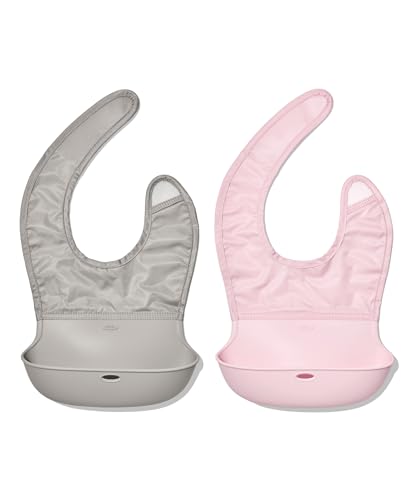
OXO Tot Waterproof Silicone Roll Up Bib
Best for: Everyday spoon-feeding and travel
A silicone bib with a wide, soft-edged catch-all pocket and a comfort-fit fabric neckband, built to fold or roll into itself for compact storage in a diaper bag. The pocket stays open on its own instead of collapsing flat, which is the detail that determines whether a bib actually catches food or just gets food dropped past it.
- Wide, self-opening catch-all pocket at the base
- Comfort-fit fabric neck strap with a hook-and-loop closure, not a string tie
- Rolls up into a compact pod for a diaper bag or restaurant
- Wipe-clean silicone; dishwasher-safe
Keep in mind: The fabric neckband is not silicone, so it should be spot-cleaned or air-dried rather than run through every dishwasher cycle with the rest of the bib.
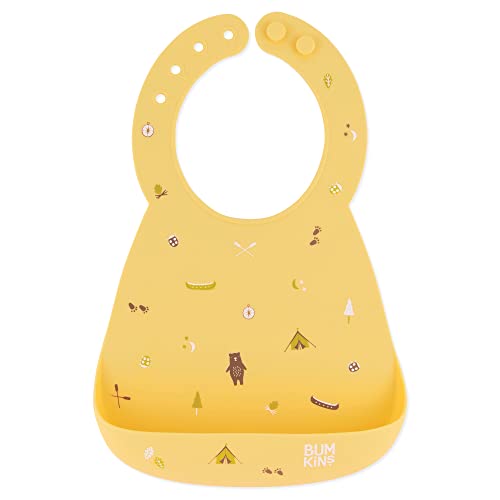
Bumkins Silicone Pocket Bib
Best for: Messy self-feeders and baby-led weaning
A one-piece, food-grade platinum silicone bib with a deep, stay-open catch-all pocket and an adjustable closure. Bumkins builds this specifically for the baby-led-weaning stage, where food is dropped in volume rather than dribbled, and the deeper pocket (compared to most fabric-and-pocket hybrids) is the main differentiator.
- Deep, stay-open pocket sized for baby-led-weaning-level mess
- One-piece platinum silicone construction — no fabric insert to separately clean
- Adjustable closure fits from 6 months through toddlerhood
- Dishwasher-safe top rack
Keep in mind: The stiffer, fully silicone neckband is less soft against the skin than a fabric-backed bib, which some parents notice with a baby who's sensitive to texture at the neck.
ezpz Mini Mat
Best for: Early self-feeding and baby-led weaning starters
A one-piece silicone placemat with a built-in, divided plate that suctions to a smooth high chair tray or table. It's sized and designed specifically for a baby just starting to self-feed, with the suction base doing the job a bib can't — keeping the plate itself from being tipped or flung during exploratory eating.
- Suction base holds to a clean, smooth, flat surface
- Built-in divided sections for separating foods
- One-piece silicone — dishwasher- and microwave-safe
- Sized for a high chair tray, not just a full-size table
Keep in mind: Suction reliability drops noticeably on a textured tray, a surface with crumbs on it, or anything that isn't perfectly flat — it's a real limitation, not a defect, but worth knowing before buying.
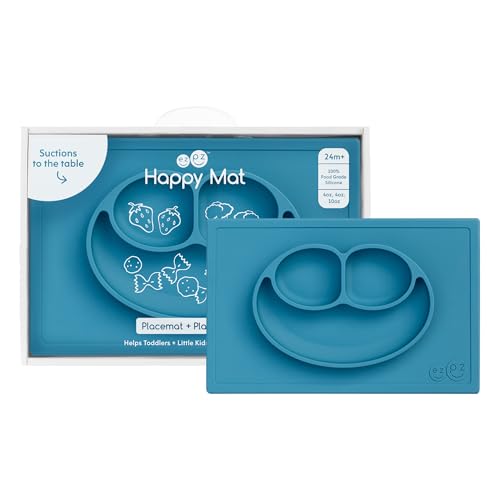
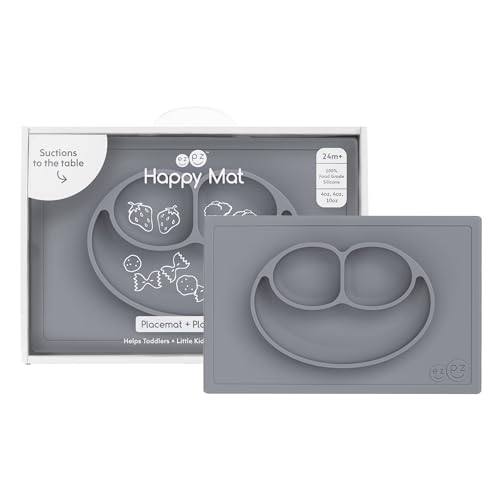
ezpz Happy Mat
Best for: Toddlers eating portioned meals
The larger, three-compartment version of ezpz's suction plate line, built for a toddler eating a full meal rather than a baby just starting solids. The three sections are sized to prompt a rough food-group split (a protein, a starch, a fruit or vegetable) without being a nutrition tool on their own.
- Three built-in compartments in one suctioned piece
- Suctions to a table or high chair tray, reducing tipped plates
- Dishwasher- and microwave-safe silicone
- Doubles as a placemat, so no separate mat needed underneath
Keep in mind: It's larger than the Mini Mat and sized for an older, more independent eater — not the right first pick for a baby just beginning purees or early self-feeding.
As an Amazon Associate I earn from qualifying purchases. Mom's Magazine may earn a commission when you buy through links on this page, at no extra cost to you. Learn more.
Frequently Asked Questions
Do I need both a bib and a placemat?
Not on day one of purees, but most families end up with both once self-feeding starts. A bib catches food that misses the mouth; a suction placemat stops the plate itself from being tipped or flung. A spoon-fed baby mostly needs the bib; a baby-led-weaning self-feeder benefits from both.
Why won't my suction placemat stay stuck to the table?
Suction only works on a smooth, flat, non-porous, clean, dry surface. A tablecloth, a textured or uneven wood table, a surface with crumbs on it, or a wet tray will all cause suction to fail or hold weakly — that's a surface issue, not usually a product defect.
Is silicone actually stain-proof?
No — it's stain-resistant, not stain-proof. Turmeric, tomato-based sauces, and beets are common culprits for leaving a faint tint, especially if the item air-dries in direct sun rather than going through a dishwasher cycle. It doesn't affect food safety.
Are silicone bibs safe to leave on a baby unsupervised?
No bib — silicone or fabric — should be left on a baby unsupervised, particularly one with a string tie, which is a strangulation risk in a car seat, crib, or anywhere unattended. Hook-and-loop or magnetic closures, like the ones on the picks above, are generally considered safer than a string tie, but the bib should still come off outside of a directly supervised meal.
Can silicone bibs and placemats go in the dishwasher?
Most are top-rack dishwasher-safe, but check the specific product — some bibs pair silicone with a fabric or plastic neckband component that should be spot-cleaned or hand-washed rather than run through repeated hot dishwasher cycles.
Related Guides
Best First Baby Foods & Best First Foods for Baby (CDC and AAP Guide)
Best first baby foods and best first foods for baby, in plain CDC and AAP terms: iron-rich starters around 6 months, one food at a time, allergen timing, first-feeding setup (bibs, spoons, cups), and what not to give. Editorially reviewed general information, not medical advice — not a ranked jar list.
Baby-Led Weaning vs. Purees: How to Choose (or Combine Both)
Baby-led weaning vs purees (and BLW vs purees combination feeding): mess, iron, gagging vs choking, and what CDC and AAP actually say about textures, readiness, and safety.
Best High Chair & Best Baby High Chair (2026): Convertible, Slim & Toddler Seats
Best high chair and best baby high chair picks for starting solids through toddler years: slim fold-flat, convertible grow-with-baby, infant recline, and portable booster.
Best Baby Food Makers of 2026: 4 Steamer-Blenders and a Manual Mill Compared
Best baby food makers of 2026 compared: BEABA Babycook Neo and Duo, Baby Brezza One Step, nutribullet Baby Steam + Blend, and the OXO Tot manual mill. One-step vs basket steamer-blender combos, capacity, twin-bowl batch cooking, cleanup and descaling, and when a pot and blender is enough.
Mom's Magazine Editorial Team
Editorial Team
The Mom's Magazine editorial team researches and writes practical, plainly-sourced guidance for parents and families. Guides are reviewed for accuracy and updated as recommendations change. Where a topic calls for professional expertise, we cite reputable organizations and, for health topics, add a qualified reviewer before publishing.
Newsletter
Get the Weekly Mom List
One short email a week: the most useful guides, activities, and picks for your family. No spam, unsubscribe anytime.