Parenting
Sweaty, Smelly Feet in Tween and Teen Athletes: A Parent's Guide (Guest Post from Dryello)
A guest post from Dryello on why young athletes' feet sweat and smell, the sports-bag and shoe habits that help, how to bring it up with your teen, when to see a doctor, and how a foot antiperspirant stick works.
Sweaty, smelly feet are very common in tween and teen athletes. Feet sweat heavily, and odor develops when skin bacteria break down that sweat inside closed cleats and sneakers. Most families can get it under control with a simple routine: wash and fully dry feet, wear moisture-wicking socks, let shoes dry between wears, and apply a foot antiperspirant to clean, unbroken skin. If sweat soaks socks even at rest, or you see itching, peeling, or cracks, check in with your pediatrician.
Guest post from Dryello. This guide was contributed by Dryello, the foot-care brand made by ProPedix, Inc., and edited by the Mom's Magazine editorial team for accuracy and tone. Dryello is a paying client of Mom's Magazine, and Dryello's foot antiperspirant is the product featured here. The full disclosure is at the bottom of the page. Everything medical below comes from the product's FDA-listed label or from public health sources we link to, and nothing here replaces advice from your child's doctor.
If you have a middle schooler or high schooler in sports, you probably know the smell. It hits you when you open the car door after practice. It's there when you walk past the mudroom, and it's worst in the sports bag that got zipped shut Friday night and opened again Monday morning. Sweaty, smelly feet are one of the most common and least talked-about parts of raising an active tween or teen. The good news is that this is usually a habits-and-products problem, not a medical one, and a few changes fix most of it. Here's what's going on, what helps, how to bring it up without a fight, and when it's worth calling the doctor.
Why young athletes' feet sweat so much, and why the smell happens
Feet sweat a lot. The soles are one of the body areas most prone to heavy sweating. The American Academy of Dermatology (AAD) lists the soles alongside the underarms, palms, and face as the places where primary hyperhidrosis, the medical term for excessive sweating, usually shows up. The AAD also notes that for most people with hyperhidrosis, signs start in childhood or adolescence. In other words, the age when your kid is lacing up cleats five days a week is also the age when heavy foot sweating tends to show up.
Sweat itself is mostly odorless. The smell comes when sweat mixes with bacteria and yeasts on the skin. The AAD describes this directly: when an area is often wet, unpleasant body odor can develop as sweat mixes with microbes on the skin. Now put that sweat inside a synthetic cleat or a basketball shoe for two hours, then into a closed bag, then into a warm car. That's close to ideal for odor. Add the hormone shifts of puberty, which often bring changes in sweat and body odor, and it's easy to see why the smell seems to show up overnight.
Sweaty feet, smelly feet, or athlete's foot?
These three get mixed up, and they need different fixes. Sweat is the moisture. Odor is what happens when bacteria work on that moisture. Athlete's foot is a fungal skin infection that thrives in the same warm, damp conditions. Because it's an infection, it needs an antifungal treatment, not just an antiperspirant. The American Academy of Pediatrics' HealthyChildren.org symptom checker describes athlete's foot as a red, scaly, cracked rash between the toes that itches and burns. It is common in teens, and it notes that before age 10 a foot rash is usually something else.
| What you notice | Most likely | What usually helps |
|---|---|---|
| Damp socks, slippery feet in shoes, no rash | Heavy sweating | Moisture-wicking socks, drying shoes out, a foot antiperspirant |
| Strong smell, skin looks normal | Odor from sweat plus bacteria | All of the above, plus airing out shoes and gear |
| Itching, burning, peeling or cracked skin between the toes | Possible athlete's foot (fungal) | An OTC antifungal used as labeled, or a doctor visit (see our treatment guide) |
| Swelling, warmth, red streaks, pus, or fever | Possible bacterial infection | Call the doctor right away |
If the skin is cracked, peeling, or itchy, skip ahead to our companion guide, the best athlete's foot treatments for kids and teens, and hold off on antiperspirant until the skin has healed. The Dryello antiperspirant label says not to use it on broken skin.
The sports-bag problem: cleats, shin guards, and the car trunk
Most foot odor gets made worse after practice, not during it. A typical sports bag holds damp socks, sweaty cleats, shin guards, a towel, and maybe a jersey, all zipped into a dark, warm space. By morning, everything has marinated. The fix is not a new bag. It's a two-minute unpacking habit that your kid can run on their own.
- Unzip the bag as soon as you're home and take everything out. Nothing wet stays in overnight.
- Socks and any sweaty base layers go straight into the laundry, not back into the bag.
- Pull cleats or court shoes open, loosen the laces, and take out removable insoles so both can air-dry.
- Shin guards and sleeves go somewhere with airflow. Wipe or wash them the way the maker's care label says.
- Leave the empty bag open to air out, especially after rainy or turf games.
- Keep a clean pair of socks and a pair of flip-flops in the bag's side pocket for the ride home.
That last item matters more than it sounds. Letting feet breathe in sandals on the drive home, instead of sitting in wet cleats for another 30 minutes, cuts down on the time skin spends in a warm, damp shoe. If your child is old enough to manage their own laundry, this is a natural spot to hand off responsibility. Our guide to age-appropriate chores for kids has ideas for teaching teens to run their own wash.
Shoes, socks, and rotation: the boring stuff that works
Dermatologists give pretty consistent advice about sweaty feet, and none of it is expensive. In its self-care tips for hyperhidrosis, the AAD recommends changing shoes and socks often, avoiding wearing the same shoes two days in a row so they can dry, choosing shoes made of natural materials like leather where possible, wearing socks labeled moisture-wicking, and using absorbent insoles or foot powder. Its athlete's foot prevention tips add washing feet daily with soap, drying them completely, and changing socks every day, or more often when they get wet.
- Socks: Look for the words "moisture-wicking" on the package. The AAD notes that not all polyester or nylon wicks, so the label matters more than the fabric name. Pack a spare pair for tournaments and double-headers.
- Rotation: If your budget allows two pairs of practice shoes, alternate them. A shoe that gets a full day off dries out much better than one worn every day.
- Drying: Open the shoes up, pull the insoles, and keep them out of the closed bag and the trunk. Fans help. Direct high heat can damage some athletic shoes, so check the maker's care guidance.
- Fit: The antifungal labels we reviewed for our treatment guide all repeat the same advice: wear well-fitting, ventilated shoes and change shoes and socks at least once a day.
- Everyday shoes: Plastic or rubber shoes trap more sweat. The AAD notes that synthetic materials like plastic and rubber are more likely to cause sweating, so sandals on hot days and breathable sneakers for school help.
Locker rooms, pool season, and sleepovers
Shared wet floors are where the fungus behind athlete's foot gets passed around. The CDC lists contact with contaminated surfaces like locker room floors as one way ringworm spreads. Athlete's foot is ringworm of the feet. The CDC's list of risk factors for athletes includes heavy sweating, reused equipment, and bare feet in locker rooms. The AAD's first prevention tip is to wear shower shoes, flip-flops, or sandals around pools, gyms, showers, locker areas, and hotel rooms.
Pool and swim season
Swim team, summer rec, and the community pool mean hours of wet feet on shared decks. A cheap pair of pool slides that live in the swim bag is one of the most useful things you can buy. After swimming, the goal is dry feet, especially between the toes, before socks and sneakers go back on. If you're heading out for a family day, our beach-day packing list is a handy place to add flip-flops and a spare towel.
Sleepovers, team trips, and camp
Overnights are where good habits tend to slip. Your kid is sharing a bathroom and a floor, and bags are zipped for days. A small personal kit takes care of most of it:
- Shower flip-flops, packed where they're easy to grab
- One pair of clean socks per day, plus one extra
- Their own towel. The CDC advises not sharing towels, socks, or sports gear.
- A plastic bag for dirty socks so they don't sit mixed in with clean clothes
- Their own foot products, labeled with their name. Sticks and powders shouldn't be shared.
How to talk to your kid about foot odor without making it worse
This is the part many parents dread. Tweens and teens can be painfully self-conscious, and "your feet stink" at the dinner table can make them feel ashamed and defensive at the same time. The AAD notes that people with heavy sweating often say they feel embarrassed, frustrated, or insecure. So how you raise it matters as much as what you say.
- Pick a private, low-stakes moment. A car ride or a quiet evening works better than in front of siblings or teammates.
- Make it about biology, not hygiene. Something like "Feet sweat a lot at your age, especially in cleats. It's super common, and there are easy fixes" takes the blame out of it.
- Offer tools, not rules. Hand over their own kit: moisture-wicking socks, flip-flops, and a product they choose. Kids take a routine more seriously when it's theirs.
- Skip the teasing, even gentle teasing. Family jokes about smelly feet can stick with a kid long after everyone else forgets them.
- Watch for bigger worries. If your child is avoiding sports, sleepovers, or taking off their shoes at a friend's house, or sweating seems to affect their mood, mention it to the pediatrician. The AAD points out that heavy sweating can affect quality of life, and there are real treatments for it.
A script that tends to land
"Hey, I've noticed your cleats and bag are getting pretty funky after practice. That happens to basically every athlete. Want to pick out some better socks and a foot stick this weekend, and we'll set up an after-practice routine?"
How a foot antiperspirant works, and where a stick fits
Antiperspirants and deodorants are different products. The AAD explains that antiperspirants help reduce sweating, while deodorants are made to mask or stop body odor, and they don't reduce sweat. In the US, antiperspirants are regulated as over-the-counter drugs, which is why they carry a Drug Facts label. Many products combine both. Powders are a third category. Most absorb moisture after it's already there rather than reducing it.
For feet, the format matters as much as the ingredient. Creams need to be rubbed in and leave hands greasy. Sprays drift, and aerosol products carry flammability warnings. Powders are messy in a shared bathroom or locker room, and they tend to end up in socks and on the floor. A solid stick that glides on is the same idea as an underarm antiperspirant, made to fit the shape of the foot.
Meet Dryello Antiperspirant Deodorant For Him and For Her
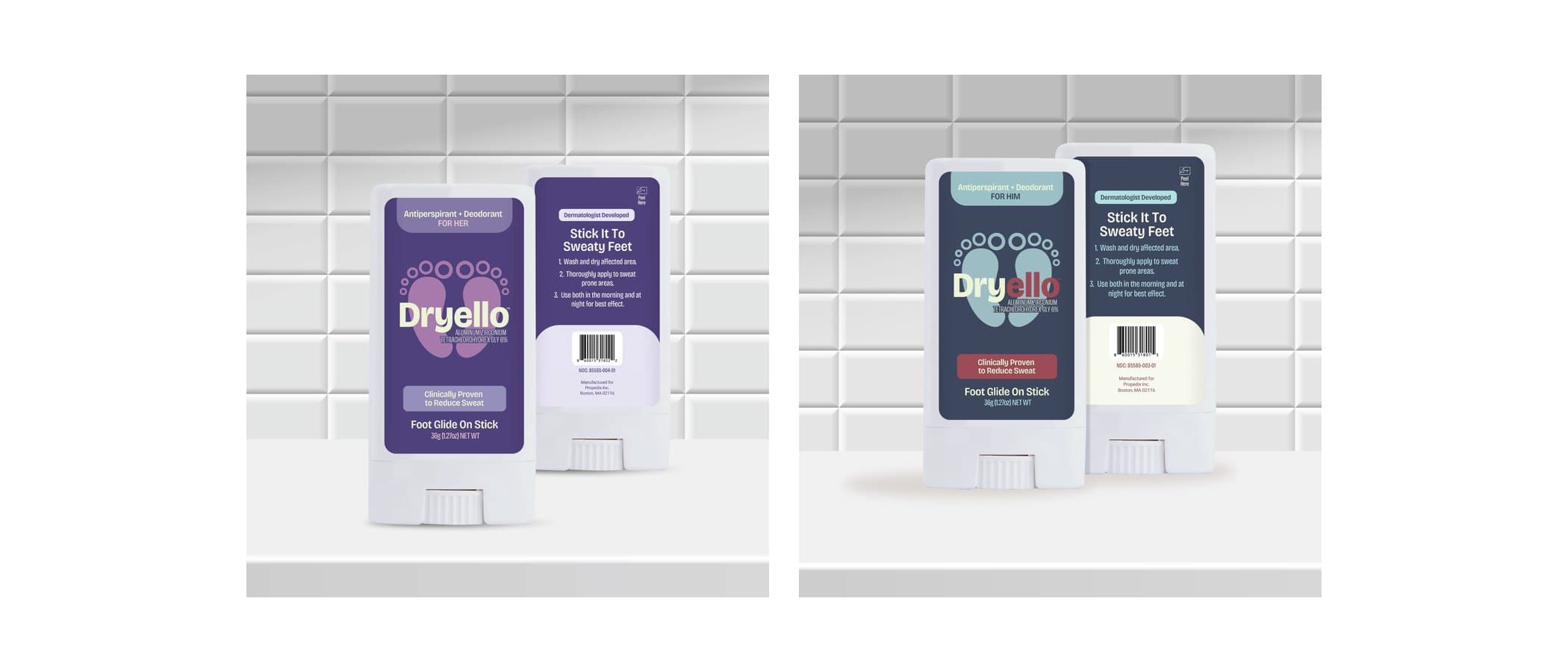
Dryello's foot antiperspirant comes in two versions, For Him and For Her. Both are glide-on sticks made for feet by ProPedix, Inc. According to the product's FDA-listed label on DailyMed, the active ingredient in both is aluminum zirconium tetrachlorohydrex gly 6%, the purpose is antiperspirant, and the use is simply "reduces sweat." The label lists a 36 g (1.27 oz) stick. For Him is NDC 85565-003 and For Her is NDC 85565-004. The package front on the label reads "Clinically Proven to Reduce Sweat."
Dryello says the two versions share the same active ingredient. The difference is scent: For Her has what Dryello calls a lighter scent profile, and the inactive ingredients in both include orange peel oil. Dryello says the sticks go on dry, so socks and shoes can go right on, and that the formula is soft enough to glide over heels, soles, and between the toes. Both were listed on dryello.com at $14.50 each as of September 2026. When we checked on September 25, 2026, For Her was showing as sold out on dryello.com. Dryello's where-to-buy page also lists Amazon and Walmart.com. You'll find both sticks, with photos and links, in the product cards further down this page.
The honest pros and cons
- Pros: It's a true antiperspirant with a Drug Facts label, not just a fragrance. The solid, glide-on format means no powder cloud and no spray drift in a shared bathroom. It's sized to live in a sports bag, and your teen can apply it without getting anything on their hands.
- Cons: It's a new product. The label shows a marketing start date of July 2026, so there's less of a track record than with long-running brands. Both versions are scented, which some kids with sensitive skin may not like. It can't be used on broken or cracked skin, and it treats sweat, not fungus, so it won't clear up athlete's foot.
- Best for: Tweens and teens in cleats, court shoes, or skates whose main problem is sweat and odor, with healthy, unbroken skin, and families who want to skip powders and sprays.
Label warnings every parent should read
- For external use only.
- Do not use on broken skin.
- Stop use if a rash or irritation occurs.
- Ask a doctor before use if you have kidney disease.
- Keep out of reach of children. If swallowed, get medical help right away.
The label doesn't list an age range. If your child is younger, or has eczema, very sensitive skin, or any kidney condition, check with your pediatrician before starting any antiperspirant.
How to apply a foot antiperspirant stick, step by step
The label directions are short: wash and dry the area, then "thoroughly apply with numerous broad strokes, including in crevices." Here's what that looks like in a real routine, using the label plus Dryello's own how-to guidance:
- Wash and dry completely. Dry skin is key. Towel off well, then dry between each toe. Dryello's instructions say not to apply it over damp skin.
- Check the skin. If there's any cracking, peeling, cuts, or a rash, skip it for now. The label says not to use it on broken skin.
- Use broad strokes over the soles. Cover the whole sole from heel to toe, the sides of the foot, and the crevices between the toes, which is where the label's "including in crevices" comes in.
- Give it a moment, then socks and shoes. Dryello says the stick goes on dry, so socks can go right on.
- Make it a daily habit. Dryello recommends applying every morning before socks and shoes. It says an evening application also works, and a second swipe can help on heavy training or travel days. Dryello also notes that, as with most antiperspirants, results build with consistent use.
- Keep it personal. One stick per person. Cap it and store it with their things, out of reach of younger siblings.
Antiperspirant is not an athlete's foot treatment
An antiperspirant reduces sweat, and it doesn't treat a fungal infection. If your teen has itching, burning, or peeling between the toes, use an antifungal treatment as the label directs (see our athlete's foot treatment guide), and don't put antiperspirant on cracked or broken skin.
A simple weekly routine for busy sports families
| When | What | Who owns it |
|---|---|---|
| Every morning | Wash or shower, dry feet completely, apply foot antiperspirant, clean moisture-wicking socks | Your teen |
| Right after practice | Flip-flops for the ride home, empty the bag, open up shoes, pull insoles | Your teen (reminder from you at first) |
| Every evening | Dirty socks in the hamper, gear somewhere with airflow, quick skin check between toes | Your teen |
| Twice a week | Swap to the second pair of practice shoes if you have one | Shared |
| Weekly | Wash insoles, shin-guard sleeves, and bag liners if the care label allows | Shared |
| Before tournaments and trips | Pack spare socks, shower shoes, own towel, own foot stick | Your teen, you double-check |
Pre-season is a good time to set this up, since you're already buying gear and filling out forms. Our back-to-school checklist by grade includes the paperwork side, like sports physicals. If your child's doctor visit is coming up anyway, it's an easy moment to mention heavy sweating. And while you're restocking the sports bag, a good bottle helps too. Here's our roundup of kids' water bottles for sports.
When sweaty feet are worth a doctor visit
Most sweaty, smelly feet are normal and respond to the routine above. The AAD describes hyperhidrosis as a medical condition that makes the body produce more sweat than it needs to cool itself, and there are effective treatments a dermatologist can offer. Check in with your pediatrician or a board-certified dermatologist if:
- Sweat soaks through socks or makes shoes slippery even when your child is resting or it's cool out.
- Sweating gets in the way of daily life, like gripping, sports, or school, or makes your child anxious or avoid activities.
- Your child sweats a lot all over the body or during sleep. The AAD notes these can be signs of secondary hyperhidrosis, which can be linked to a medication or another condition.
- The skin between the toes is itchy, peeling, cracked, or raw, which could be athlete's foot. HealthyChildren.org advises calling if a rash isn't better after a week of treatment or isn't gone after two weeks, or if it has spread to the top of the foot or your child is under 10.
- You see signs of a bacterial infection: swelling, warmth, red streaks, pain, pus, or fever. MedlinePlus says to contact a provider right away if these appear.
- Your child has diabetes, a weakened immune system, or another condition that affects the skin or circulation. In that case, any foot problem deserves a professional look.
Disclosure
Full disclosure: Dryello is a paid client
This is a sponsored guest post. Dryello (ProPedix, Inc.) is a paying client of the publisher of Mom's Magazine. Dryello contributed this article, and we edited it. The Dryello product links on this page are sponsored links. Dryello's products are featured first because of that paid relationship, not because of an independent ranking. Mom's Magazine did not lab-test or independently test these products. Product details come from each product's label and the maker's own descriptions, and prices can change. This article is general information, not medical advice. For heavy sweating, rashes, or any foot problem that isn't getting better, talk with your child's pediatrician or a dermatologist.
Our Recommendations
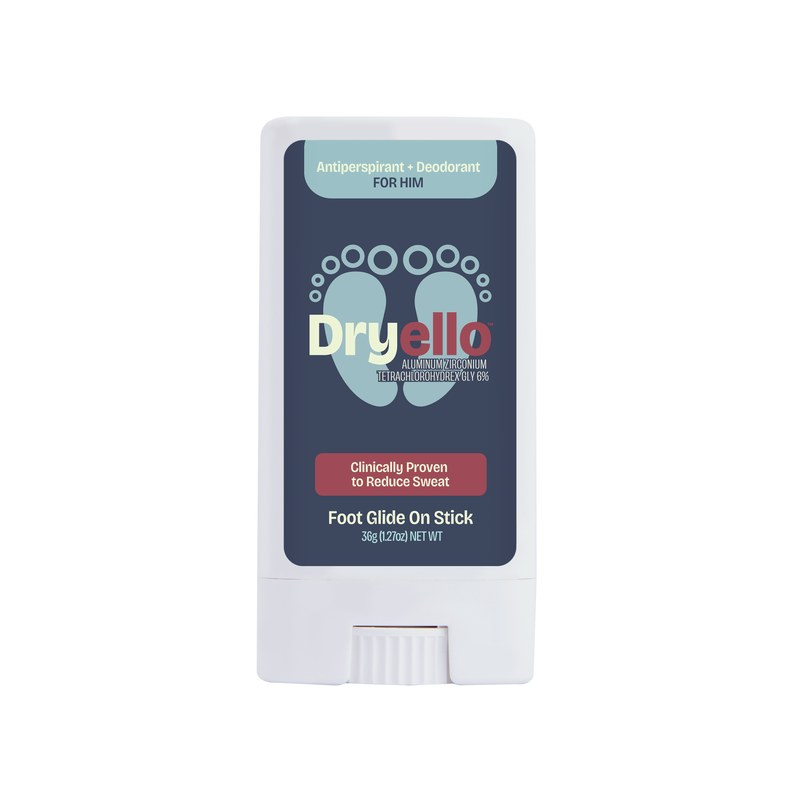
Dryello Antiperspirant Deodorant Foot Glide-On Stick — For Him
Best for: Teen athletes in cleats, court shoes, or skates whose main issue is sweat and odor
Sponsored (Dryello is a paid client). A glide-on foot antiperspirant from ProPedix, Inc. Its FDA-listed label gives aluminum zirconium tetrachlorohydrex gly 6% as the active ingredient, with the use "reduces sweat." Listed on dryello.com at $14.50 as of September 2026.
- Active: aluminum zirconium tetrachlorohydrex gly 6% (Drug Facts label)
- 36 g (1.27 oz) stick per label; NDC 85565-003
- Solid glide-on format: no powder cloud or spray
- Label: not for broken skin; ask a doctor first if you have kidney disease
Keep in mind: Scented, and new in 2026. It reduces sweat but doesn't treat athlete's foot, and the label doesn't list an age range, so ask your pediatrician for younger kids.
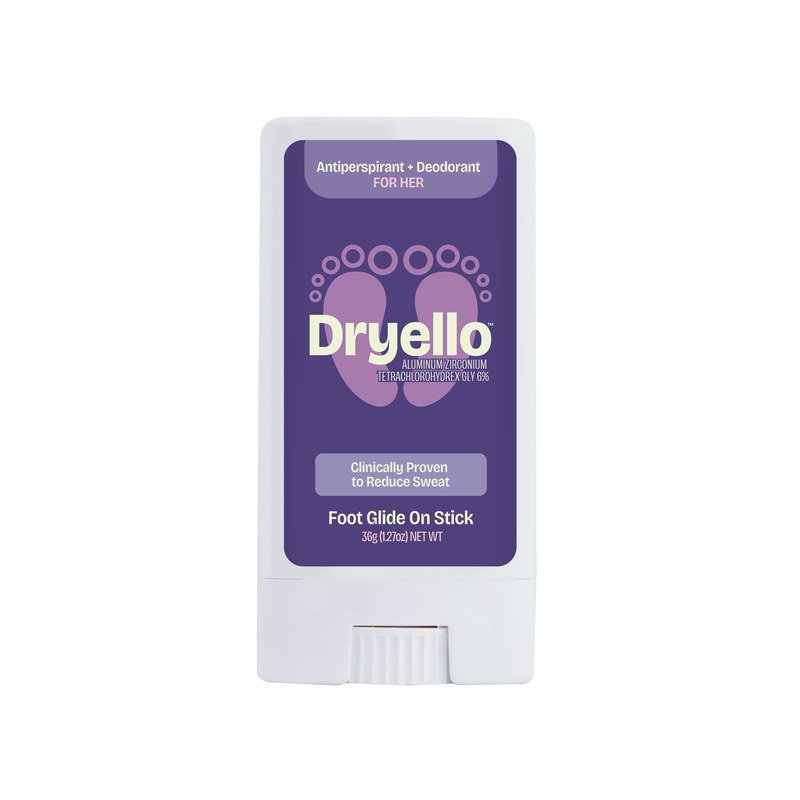
Dryello Antiperspirant Deodorant Foot Glide-On Stick — For Her
Best for: Dancers, runners, and athletes who want the same formula with a lighter scent
Sponsored (Dryello is a paid client). Same active ingredient and label directions as For Him. Dryello describes For Her as having a lighter scent profile. Listed at $14.50 on dryello.com as of September 2026, but it was showing as sold out there when we checked on September 25, 2026.
- Active: aluminum zirconium tetrachlorohydrex gly 6% (Drug Facts label)
- 36 g (1.27 oz) stick per label; NDC 85565-004
- Lighter scent profile, per Dryello
- Apply to clean, dry feet with broad strokes, including between the toes
Keep in mind: Showing sold out on dryello.com when we checked. Dryello's where-to-buy page also lists Amazon and Walmart.com. Scented, and not for broken or irritated skin.
As an Amazon Associate I earn from qualifying purchases. Mom's Magazine may earn a commission when you buy through links on this page, at no extra cost to you. Learn more.
Frequently Asked Questions
Why do my teen's feet smell so bad all of a sudden?
Feet sweat heavily, and the American Academy of Dermatology notes that heavy sweating often starts in childhood or adolescence. Sweat itself is mostly odorless. The smell comes from bacteria and yeasts on the skin breaking it down, and closed cleats, damp socks, and a zipped sports bag give them an ideal warm, wet environment. Drying feet completely, changing into clean moisture-wicking socks, letting shoes air out, and using an antiperspirant made for feet usually help a lot.
Is it OK for a tween or teen to use a foot antiperspirant?
Foot antiperspirants are over-the-counter products, and Dryello's label doesn't list an age range. Its warnings say to use it externally only, not on broken skin, to stop if a rash or irritation occurs, and to ask a doctor before use if you have kidney disease. For younger kids, or kids with eczema, very sensitive skin, or a kidney condition, check with your pediatrician first. Always follow the product label.
What's the difference between foot antiperspirant, deodorant, and foot powder?
An antiperspirant reduces sweat and is regulated as an over-the-counter drug with a Drug Facts label. A deodorant masks or neutralizes odor but doesn't reduce sweat, according to the AAD. Most foot powders absorb moisture that's already there. Many families use an antiperspirant in the morning and rely on shoe rotation and fresh socks for the rest.
How can I tell if it's athlete's foot and not just sweaty feet?
Sweaty or smelly feet usually look normal. Athlete's foot, a fungal infection, typically causes a red, scaly, cracked rash between the toes that itches or burns, according to HealthyChildren.org. It is common in teens but uncommon before about age 10. If you see itching, peeling, or cracking, use an antifungal treatment as the label directs, or call your pediatrician, and don't use antiperspirant on broken skin.
When should sweaty feet be checked by a doctor?
See your pediatrician or a dermatologist if sweat soaks socks even at rest or in cool weather, interferes with sports or school, happens all over the body or during sleep, or comes with a rash that isn't improving. Call right away for swelling, warmth, red streaks, pus, or fever. Children with diabetes or circulation problems should have any foot problem checked by a clinician.
How do we get the smell out of cleats and sports shoes?
Start by drying them out after every use. Open them up, loosen the laces, pull out the insoles, and keep them out of a closed bag or a hot trunk. If you can, alternate between two pairs so each gets a full day to dry, as the AAD suggests. Wash insoles and liners only as the maker's care label allows. Reducing how much sweat goes into the shoe in the first place, with moisture-wicking socks and a foot antiperspirant, also helps over time.
Sources & Further Reading
- Dryello Antiperspirant Deodorant For Him / For Her Foot Glide On Stick — Drug label — DailyMed, U.S. National Library of Medicine (reviewed 2026-09-25)
- Hyperhidrosis: Signs and symptoms — American Academy of Dermatology (reviewed 2026-09-25)
- Hyperhidrosis: 6 tips dermatologists give their patients — American Academy of Dermatology (reviewed 2026-09-25)
- How to prevent athlete's foot — American Academy of Dermatology (reviewed 2026-09-25)
- What Causes Ringworm — Centers for Disease Control and Prevention (reviewed 2026-09-25)
- Athlete's Foot — Symptom Checker — American Academy of Pediatrics (HealthyChildren.org) (reviewed 2026-09-25)
- Athlete's foot — MedlinePlus Medical Encyclopedia, U.S. National Library of Medicine (reviewed 2026-09-25)
Related Guides
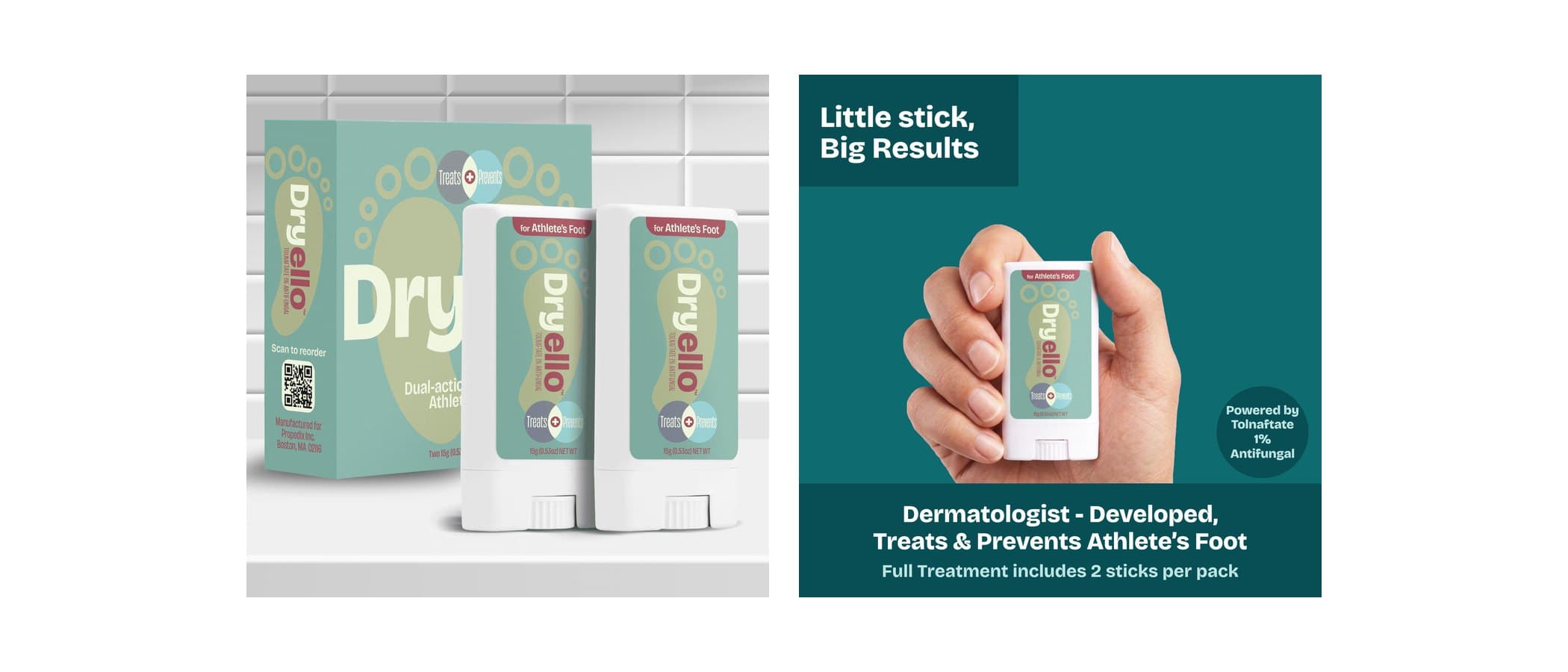
Best Athlete's Foot Treatments for Kids and Teens (2026)
Seven over-the-counter athlete's foot treatments compared by active ingredient, label age, and course length, plus how to tell if it's really athlete's foot, how to use treatment so it works, and when to call the pediatrician.
Back-to-School Checklist by Grade
A practical, grade-by-grade back-to-school checklist covering supplies, routines, and paperwork.

Age-Appropriate Chores for Kids
Age-by-age chore ideas for toddlers through school-age kids, plus how to handle allowance and what to do when a chore chart stops working.
Best Water Bottles for Kids (2026): Preschool, Lunch Bag & Sports
Best water bottle for kids by job — preschool carry, school lunch bag, sports bag, and older-kid dual spout — plus leak tests, cleaning to stop straw mold, size by age, and CDC/AAP water guidance.
Mom's Magazine Editorial Team
Editorial Team
The Mom's Magazine editorial team researches and writes practical, plainly-sourced guidance for parents and families. Guides are reviewed for accuracy and updated as recommendations change. Where a topic calls for professional expertise, we cite reputable organizations and, for health topics, add a qualified reviewer before publishing.
Newsletter
Get the Weekly Mom List
One short email a week: the most useful guides, activities, and picks for your family. No spam, unsubscribe anytime.