Products
Best Toddler Halloween Costumes 2026: Top 4 Picks + Safety Checks
The best toddler costumes for Halloween 2026: four Amazon picks (a fleece animal romper, a Disney Winnie the Pooh plush jumpsuit, a Very Hungry Caterpillar tunic, and a pumpkin set) compared on listing facts, plus flame-resistance, mask, and visibility checks by age.
As an Amazon Associate I earn from qualifying purchases.Some links on this page are affiliate links. If you buy through them, Mom's Magazine may earn a small commission at no extra cost to you. It never changes which products we recommend. How we recommend products.
The best toddler Halloween costumes for 2026 are soft, mask-free, and quick to put on. Our four picks: a TONWHAR hooded fleece animal romper for 1- and 2-year-olds, the Disguise Winnie the Pooh plush jumpsuit for a licensed character without a mask, the Rubie's Very Hungry Caterpillar tunic to wear over regular clothes, and a Spooktacular Creations pumpkin set. Whatever you buy, look for a "Flame Resistant" label on the costume and any hat or wig. That is the AAP's advice. Skip masks for kids under about 3, and add reflective tape for after dark. We researched these picks from Amazon listings and CPSC and AAP safety guidance. We did not wear-test them.
Quick picks
| Product | Best for | |
|---|---|---|
| TONWHAR Hooded Animal Romper Costume Best for Ages 1–2 | 1- and 2-year-olds, cold nights, and easy diaper changes | Check price on Amazon |
| Disguise Winnie the Pooh Plush Jumpsuit Best Licensed Character | A licensed character with no mask | Check price on Amazon |
| Rubie's Very Hungry Caterpillar Costume Best Over-Clothes Costume | Layering over regular clothes on a cold night | Check price on Amazon |
| Spooktacular Creations Pumpkin Costume Best Classic Pick | A classic look and matching siblings | Check price on Amazon |
| Disguise Elmo Comfy Costume Licensed character jumpsuit | Sesame Street fans | Check price on Amazon |
| Spooktacular Creations Baby Lion Costume Four-piece animal set | A complete set with booties and a toy | Check price on Amazon |
| Spooktacular Creations Baby Bumble Bee Costume Flannel romper with wings | A soft flannel costume with wings | Check price on Amazon |
| Spooktacular Creations T. rex Costume Dinosaur jumpsuit set | Dinosaur fans | Check price on Amazon |
| Rubie's Plush Chicken Toddler Costume Plush romper | A simple romper that goes on fast | Check price on Amazon |
Best toddler Halloween costumes of 2026 at a glance
Parents searching for the best toddler costumes for 2026 usually want three things: something a toddler will actually keep on, something that passes a basic safety check, and something that looks like a costume in photos. The four picks below each cover a different job. None of them needs a mask. We compared them using only what the Amazon listing or brand states: fabric, what's in the box, sizes, and how it closes. We have no stars, test scores, or prices. Prices change daily in October, so check the live listing.
| Costume | What's included (per listing) | Fabric (per listing) | Closure / fit notes | Listed sizes |
|---|---|---|---|---|
| TONWHAR Hooded Animal Romper Costume | One-piece hooded romper (dinosaur and other animals) | Soft plush fleece | Full-length two-way zipper that opens from the bottom for diaper changes; roomy fit for layering over clothes | Multiple sizes, infant through 5 years |
| Disguise Winnie the Pooh Plush Jumpsuit | Double-sided plush jumpsuit with attached character hood | 100% polyester; plush inside and out | Officially licensed Disney costume; hood attached, no mask | 12–18 months, 2T, 3T–4T |
| Rubie's Very Hungry Caterpillar Costume | Padded fleece tunic and headpiece with antennae | Fleece tunic | Shirt and pants not included; Rubie's notes costumes run smaller than apparel | Toddler sizes including 2T (check the size chart) |
| Spooktacular Creations Pumpkin Costume | 3-piece set: pumpkin hood, pumpkin suit, green long socks | 100% polyester | Listing says it meets U.S. toy safety testing | 6–12 months through Small (5–7 years) |
Flame resistance: none of these four listings states it in the product bullets. Polyester and nylon are the fabrics CPSC calls flame-resistant, and two picks are listed as 100% polyester. Still, the AAP's advice is to look for "flame resistant" on the costume label itself. Check the sewn-in tag when the package arrives, before you cut tags or throw away the packaging.
Who each costume is for (and who should skip it)
TONWHAR Hooded Animal Romper Costume
A one-piece fleece romper with a cartoon animal hood. The dinosaur version is the one most families search for. TONWHAR's listing highlights a full-length two-way zipper that opens from the bottom, so you can change a diaper without taking the whole costume off. It also has a roomy cut meant to go over regular clothes. It doubles as winter playwear after October.
- Who it's for: 1- and 2-year-olds, cold-weather trick-or-treating, toddlers still in diapers, and kids who fight anything tight or scratchy.
- Skip it if: your party or trick-or-treat route is indoors and warm, since fleece can overheat. Also skip it if you need a clearly labeled flame-resistant garment and the tag you receive doesn't say so.
- Check before Halloween: pull the hood up and confirm your toddler can see to the sides. Fold the hood back for stairs and curbs if it slips forward.
Check price on AmazonTONWHAR Hooded Animal Romper Costume
Disguise Winnie the Pooh Plush Jumpsuit
An officially licensed Disney costume from Disguise: a double-sided plush jumpsuit with Pooh's hood attached. The listing says it is 100% polyester with plush inside and outside, sold in 12–18 months, 2T, and 3T–4T. A soft character toddlers recognize, with no mask, no cape, and no small add-on accessories.
- Who it's for: a 2- to 4-year-old who loves Pooh, families who want a licensed character without a mask, and cold nights when plush adds warmth.
- Skip it if: your child runs hot or you'll spend most of the night inside, since plush on both sides is warm. Skip it too if your toddler hates hoods.
- Check before Halloween: size by the height and weight chart, not age alone. Walk a flight of stairs in it to confirm the legs aren't long enough to trip on.
Check price on AmazonDisguise Winnie the Pooh Plush Jumpsuit
Rubie's Very Hungry Caterpillar Costume
An officially licensed costume based on Eric Carle's book, from Rubie's: a padded fleece tunic with the caterpillar's green segments and a red headpiece with antennae. The listing is clear that the shirt and pants are not included. You layer it over your own clothes, which is the most practical approach for a cold October night. Rubie's also notes that its costumes run smaller than regular clothes.
- Who it's for: toddlers who won't tolerate a full-body costume, book-week or daycare parades, and families who want to layer thermals or a jacket underneath.
- Skip it if: you want a one-piece costume that makes a full outfit by itself. You'll need to supply the base layer.
- Check before Halloween: make sure the headpiece sits snugly and does not slide over your child's eyes. The AAP says hats should not block vision. Size up if your toddler is at the top of the chart.
Check price on AmazonRubie's Very Hungry Caterpillar Costume
Spooktacular Creations Pumpkin Costume
A classic 3-piece pumpkin set: a pumpkin hood, a matching suit, and a pair of green long socks. The listing says it is 100% polyester and meets U.S. toy safety testing, and it runs from 6–12 months up to kids' Small (5–7 years). That range makes it easy to match siblings.
- Who it's for: babies and young toddlers, sibling or family themes, and parents who want an instantly recognizable look with no character licensing.
- Skip it if: your toddler refuses anything on their head. The look depends on the hood. Or skip it if you want a costume that works as everyday pretend-play gear afterward.
- Check before Halloween: socks on hard floors are slippery. Swap in real shoes or grippy socks for the walk.
Check price on AmazonSpooktacular Creations Pumpkin Costume
How we picked
This is a researched buying guide. We have not dressed a toddler in every costume and timed how long it survives a trick-or-treat loop. We started with the safety rules that govern retail costumes: the Flammable Fabrics Act, enforced by the Consumer Product Safety Commission. We added current CPSC seasonal guidance and the AAP's HealthyChildren.org Halloween costume tips. Then we chose one real product for each common toddler costume type: a fleece animal romper, a licensed plush character, a tunic you layer over clothes, and a simple themed set. Everything in the comparison table comes from the Amazon listing or the brand. Costume lines get restocked and resized every year, so the checks below apply to whatever costume you end up buying.
The flame-resistance label, and what it actually promises
Costumes sold in U.S. stores fall under the Flammable Fabrics Act. That's why a mainstream toddler costume usually has a "Flame Resistant" tag on the packaging or the garment. The label promises less than it sounds like. It means the fabric resists catching fire and is designed to put itself out quickly once it's away from the flame. It does not mean the costume is fireproof. CPSC calls out nylon and polyester as fabrics that resist burning, which is one reason so many licensed costumes are synthetic rather than cotton flannel.
If you make or alter a costume, the piece you add isn't covered by retail flammability testing. That includes a cape, a tail, or trim on a base outfit. CPSC's advice to choose nylon or polyester over cotton or loosely woven fabric applies to anything you add. A cotton robe or old flannel shirt made into a costume burns faster and doesn't put itself out the way a labeled synthetic costume does.
Visibility and trip hazards: the part that isn't about fire at all
Trick-or-treating happens at dusk and after dark, on sidewalks and driveways with uneven curbs. CPSC and the AAP both say costumes should be bright and reflective. Reflective tape that catches headlights does more after dark than a bright color that only shows up in daylight photos. For a toddler, the simple version is a strip of reflective tape on the treat bucket or stroller, plus a flashlight in an adult's hand. Don't assume a red cape is visible to a driver forty feet away in the dark.
The other half of this has nothing to do with headlights. The AAP says costumes should be short enough to prevent tripping and shouldn't catch on things. That matters most for a toddler who is still working on balance. Watch for a long dragging cape, billowy sleeves that catch on railings, or oversized plastic shoes. They all raise the odds of a fall at the moment you're also juggling a treat bucket, a flashlight, and a sibling. Hem it, size it properly, or choose a different costume for a toddler than you would for an older child.
Check light-up accessories for a secured battery compartment
Light-up costume accessories and party favors are a real, recurring hazard. In 2026, a 50-pack of light-up party favor rings was recalled because a child could pry open the battery compartment. That exposed small button batteries, which are a serious swallowing and internal-burn risk for toddlers. Before you buy any light-up piece, check that the battery door screws shut. If in doubt, skip battery-powered accessories for children under 3 and use reflective tape instead.
Masks, hoods, and why most of them are a hard no under 3
A full-face mask is one of the easiest costume pieces to cut for a toddler, even if the character technically "needs" one. The AAP suggests non-toxic makeup and decorative hats as safer alternatives to masks. It also says to test makeup on a small patch of skin first, and that hats should not slide over the eyes. A soft hood that stays open around the face does most of what a mask does, like a fox hood with ears or a dinosaur hood with a soft ridge. All four picks above use a hood or headpiece, not a mask.
Three costume categories, and which fits which toddler
| Costume type | Best for | Watch for | Example on this page |
|---|---|---|---|
| Licensed character costume | A toddler with a strong favorite character | Capes, wands, or accessories that add a trip or poke hazard; check whether the character needs a mask before buying | Disguise Winnie the Pooh Plush Jumpsuit |
| Fleece or plush animal onesie | Ages 1–2 especially, cold climates, toddlers who resist anything tight or scratchy | Warmest option but can overheat indoors; check that the hood doesn't block side vision | TONWHAR Hooded Animal Romper Costume |
| Tunic or accessory dress-up over regular clothes | Toddlers who won't wear a full costume, last-minute needs, reuse for pretend play | Least warm by itself; layer it over real clothing outdoors | Rubie's Very Hungry Caterpillar Costume |
What actually changes by age
- Under 18 months: a soft animal onesie or a simple themed set, like the pumpkin set's smallest sizes, is usually as much as a baby will tolerate. No mask and no small detachable accessories, ever.
- 18 months–2 years: fleece rompers and simple hooded costumes tend to work best. Toddlers this age often refuse anything that pulls slowly over the head or feels tight at the neck. A zip-front romper goes on fast, and a fight at the door is a bad way to start the evening.
- 3–4 years: usually the first year a toddler has a real opinion about the character. That's where licensed costumes like the Pooh jumpsuit start to earn their higher price. Vision and mobility checks still apply. Have your child walk up and down a few stairs in the full costume, shoes included, before Halloween night.
- 5 and up: kids this age can usually handle more elaborate pieces and understand "don't run in the cape." The flame-resistance and visibility guidance above still applies in full.
Cold-weather trick-or-treating: layer under, not over
Most costumes, especially licensed synthetic ones, aren't built for real outdoor temperatures after sunset in October. Thermal leggings and a long-sleeve shirt under the costume work better than squeezing a winter coat over it. That's one reason tunic-style costumes like the Caterpillar are practical. If you drive between neighborhoods, the usual car-seat rule still applies: no puffy coat under the harness.
When to buy, and how sizing actually plays out
September is the right month to shop if a specific character or size matters. Popular toddler costumes often sell out of the smallest sizes weeks before Halloween, and a sold-out size usually isn't restocked that season. Buying early has one risk: a toddler's favorite character can change completely between September and October 31. Check the return window before you buy, and keep the tags on until close to the holiday.
Sizing varies more than parents expect. Rubie's says its costumes run smaller than regular clothes, while plush rompers are often cut roomy to fit over layers. Don't assume "2T" means the same thing at every brand. Check the height and weight chart on the listing, and size up if your toddler is at the top of their range or will wear thermals underneath.
When to skip the elaborate costume entirely
Not every toddler needs, or wants, a full costume. A toddler in a clingy, don't-touch-me phase with new textures often does better in a simple hat-and-shirt combo than a full-body costume they'll try to pull off right away. The same goes for tight budgets, several kids in fast-changing sizes, or a toddler who'll wear a costume once and lose interest. A tunic, a set of ears, or a themed shirt still reads as a costume in photos, at a fraction of the cost and without the overheating or mask risk.
Getting more than one night out of it
Costumes built around soft, open pieces tend to get a second life as pretend-play gear after October 31. Think a hood with ears, a tunic, or a romper that doubles as winter loungewear. That makes paying a little more easier to justify. Keep the everyday dress-up bin free of small detachable parts and button batteries, for the same reasons that apply on Halloween night.
Check current prices on the four picks
Sizes and colors sell through fast in October, so tap through for live availability. We don't list prices on this page. Each link goes to the exact Amazon listing we compared above.
Check TONWHAR Hooded Animal Romper on AmazonAffiliate link. Fleece zip romper; pick your animal and size on the listing.
Check Disguise Winnie the Pooh Plush Jumpsuit on AmazonAffiliate link. Licensed Disney plush jumpsuit with attached hood.
Check Rubie's Very Hungry Caterpillar Costume on AmazonAffiliate link. Tunic and headpiece; shirt and pants not included.
Check Spooktacular Creations Pumpkin Costume on AmazonAffiliate link. 3-piece pumpkin set.
Our Recommendations

TONWHAR Hooded Animal Romper Costume
Best for: 1- and 2-year-olds, cold nights, and easy diaper changes
A one-piece plush fleece romper with a cartoon animal hood. The listing highlights a full-length two-way zipper that opens from the bottom for diaper changes and a roomy fit for layering. The listing doesn't state flame resistance, so check the garment tag.
- Soft plush fleece hooded romper (per listing)
- Full-length two-way zipper opens from the bottom for diaper changes
- Roomy fit designed to layer over clothes
- Sold in multiple animals and sizes from infant up to 5 years
Keep in mind: Warm fleece can overheat indoors, and the listing does not state flame resistance. Confirm the sewn-in label.

Disguise Winnie the Pooh Plush Jumpsuit
Best for: A licensed character with no mask
An officially licensed Disney jumpsuit from Disguise. It's double-sided plush with Pooh's hood attached, listed as 100% polyester. It has no mask, no cape, and no loose accessories.
- Double-sided plush jumpsuit with attached character hood
- 100% polyester, plush inside and out (per listing)
- Officially licensed Disney costume
- Listed sizes: 12–18 months, 2T, 3T–4T
Keep in mind: Plush on both sides is warm for indoor parties. Size by the chart so the legs don't drag.

Rubie's Very Hungry Caterpillar Costume
Best for: Layering over regular clothes on a cold night
An officially licensed Eric Carle costume: a padded fleece tunic and a headpiece with antennae. The shirt and pants are not included, so it goes over your own base layer. Rubie's notes costumes run smaller than regular clothes.
- Includes padded fleece tunic and headpiece with antennae
- Shirt and pants not included, so you layer over regular clothes
- Officially licensed The World of Eric Carle costume
- Rubie's says costumes run smaller than apparel; check the size chart
Keep in mind: Not a complete outfit by itself. The headpiece needs a snug fit so it doesn't slip over the eyes.
Spooktacular Creations Pumpkin Costume
Best for: A classic look and matching siblings
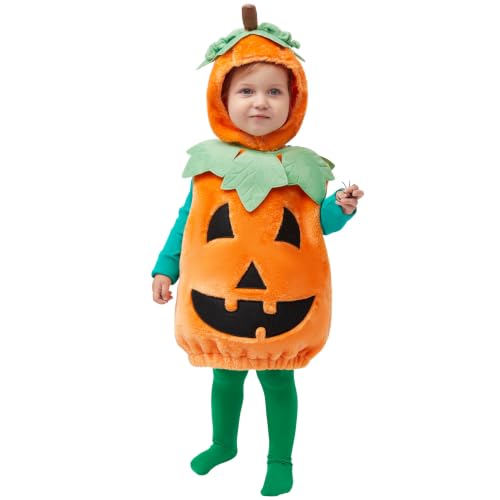
A 3-piece pumpkin set with a hood, a pumpkin suit, and green long socks. The listing says it is 100% polyester and meets U.S. toy safety testing, in sizes from 6–12 months to kids' Small (5–7 years).
- 3-piece set: pumpkin hood, pumpkin suit, green long socks
- 100% polyester (per listing)
- Listing states it meets U.S. toy safety testing
- Sizes from 6–12 months through Small (5–7 years)
Keep in mind: The look depends on the hood, and the socks can be slippery on hard floors. Add grippy socks or shoes.

Disguise Elmo Comfy Costume
Best for: Sesame Street fans
An officially licensed plush Elmo jumpsuit for toddlers, with hook-and-loop (Velcro) closures. The linked listing is size Medium (3T–4T).
- Officially licensed Sesame Street costume
- Plush jumpsuit design
- Velcro closures
- Linked size: Medium (3T–4T)
Keep in mind: Plush fabric runs warm for mild-weather trick-or-treating or indoor parties.
Spooktacular Creations Baby Lion Costume
Best for: A complete set with booties and a toy
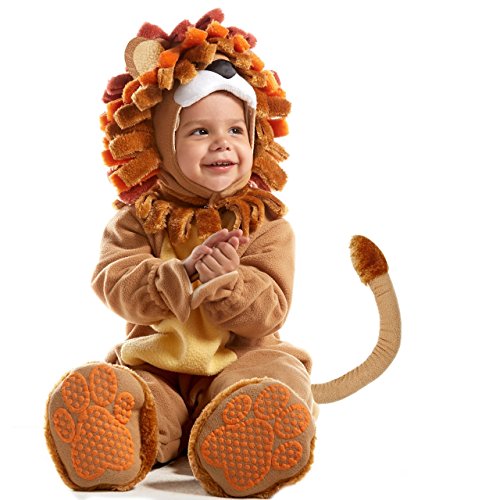
A four-piece lion set: a 3D lion hat, a suit with a tail, booties, and a plush toy zebra. It's 100% polyester, and the maker says it's easy to open for diaper changes.
- Hat, suit with tail, booties, and plush zebra
- 100% polyester
- Easy access for diaper changes
- Sizes from 6–12 months up to small (5–7 yrs)
Keep in mind: Hats and booties are easy for toddlers to pull off, so expect to carry the pieces part of the night.

Spooktacular Creations Baby Bumble Bee Costume
Best for: A soft flannel costume with wings
A bumble bee set with a plush hood with antennae, a striped flannel romper, and a pair of wings. It's 100% polyester with a loose fit.
- Plush hood with antennae, flannel romper, and wings
- 100% polyester, loose fit
- Check the size chart. The linked listing is 18–24 months
Keep in mind: The maker recommends spot or hand washing only, not machine washing.

Spooktacular Creations T. rex Costume
Best for: Dinosaur fans
A dinosaur set with a hood with a 3D T. rex face, a jumpsuit with tail, booties, and a fabric dinosaur egg. It's 100% polyester and comes in sizes from 12–18 months up.
- Hood, jumpsuit with tail, booties, and fabric egg
- 100% polyester
- Sizes from 12–18 months to medium (8–10 yrs)
- Hand wash cold, line dry
Keep in mind: Hand wash only, which matters for a costume that also gets worn for dress-up.
Rubie's Plush Chicken Toddler Costume
Best for: A simple romper that goes on fast
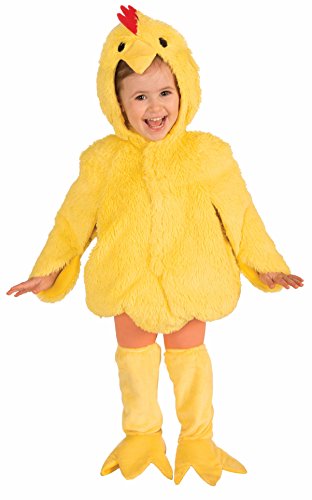
A plush hooded chicken romper with boot tops and hook-and-loop closure, in toddler size. Tights aren't included.
- Hooded romper and boot tops
- Hook-and-loop closure
- Toddler size. Rubie's notes costumes run smaller than regular clothes
Keep in mind: Tights aren't included, and Rubie's says to size up because costumes run small.
As an Amazon Associate I earn from qualifying purchases. Mom's Magazine may earn a commission when you buy through links on this page, at no extra cost to you. Learn more.
Frequently Asked Questions
What are the best toddler Halloween costumes for 2026?
For most toddlers, the best costume is soft, mask-free, and fast to put on. Our four 2026 picks: a TONWHAR hooded fleece animal romper for ages 1–2, the Disguise Winnie the Pooh plush jumpsuit for a licensed character, the Rubie's Very Hungry Caterpillar tunic to layer over clothes, and a Spooktacular Creations pumpkin set. Check the label on whichever you buy for "Flame Resistant," as the AAP recommends.
Does "Flame Resistant" on a costume label mean it can't catch fire?
No. It means the fabric is designed to resist catching fire and to put itself out quickly once it's away from the flame. It is not fireproof. Keep every costume away from candles, fire pits, and space heaters, labeled or not. That habit is more reliable than the label alone.
Is a mask ever okay for a toddler's costume?
Generally no for children under about 3. Rigid or tight masks limit side vision and can make breathing harder. The AAP suggests non-toxic makeup, patch-tested first, or a decorative hat that doesn't slide over the eyes instead.
How do I make a costume safer for trick-or-treating after dark?
Add reflective tape to the costume, treat bucket, or stroller rather than relying on the costume's color. Carry a flashlight, and stay on well-lit streets. If you use a light-up accessory, check that the battery compartment screws shut instead of snapping open.
What should I check before buying a light-up costume accessory?
Confirm the battery compartment needs a screwdriver to open, not a simple snap or slide a toddler could open. Light-up party favors with easy-open battery doors have been recalled for exactly this reason, because button batteries are a serious swallowing hazard.
How early should I buy a toddler Halloween costume?
September is a good time if a specific character or size matters, since popular toddler sizes sell out before Halloween. Check the return or exchange policy first, because a toddler's costume preference can change before October 31.
Should I size up in toddler costumes?
Often, yes, but check the chart. Rubie's says its costumes run smaller than regular clothes, while fleece rompers are often cut roomy for layering. Size up if your toddler is at the top of their range or will wear thermals underneath. Hem anything long enough to trip on.
Sources & Further Reading
- Halloween Fun & Safety Tips for Kids of All Ages — American Academy of Pediatrics (HealthyChildren.org) (reviewed 2026-09-26)
- Halloween Safety Tips for Selecting Costumes and Decor — U.S. Consumer Product Safety Commission (CPSC) (reviewed 2026-09-12)
- CPSC Offers Safety Tips to Keep Hazards from Haunting Your Halloween — U.S. Consumer Product Safety Commission (CPSC) (reviewed 2026-09-12)
Related Guides
Screen-Free Activities for Kids
Screen-free activities for kids across ages: off-screen play as a habit, AAP Family Media Plan zones, and CDC screen lines.
Best Toddler Winter Coats, Jackets and Snowsuits of 2026
The best toddler winter coats, jackets and snowsuits for 2026: bunting vs. two-piece, water-resistant vs. waterproof shells, sizing for a growing season, and why a puffy coat never goes under a car seat harness.
Birthday Party Planning Checklist
A step-by-step kids' birthday party planning checklist and timeline that keeps it simple.
Mom's Magazine Editorial Team
Editorial Team
The Mom's Magazine editorial team researches and writes practical, plainly-sourced guidance for parents and families. Guides are reviewed for accuracy and updated as recommendations change. Where a topic calls for professional expertise, we cite reputable organizations and, for health topics, add a qualified reviewer before publishing.
Newsletter
Get the Weekly Mom List
One short email a week: the most useful guides, activities, and picks for your family. No spam, unsubscribe anytime.