New Moms
How to Swaddle a Newborn Safely: Step-by-Step (and When to Stop)
Hip-healthy swaddling technique step by step, why a snug wrap needs room at the hips, and the specific sign — not an age on a calendar — that means it's time to stop.
As an Amazon Associate I earn from qualifying purchases.Some links on this page are affiliate links. If you buy through them, Mom's Magazine may earn a small commission at no extra cost to you. It never changes which products we recommend. How we recommend products.
Swaddling — wrapping a newborn snugly in a blanket or wearable sack, arms in — helps many newborns sleep longer by limiting the startle (Moro) reflex that otherwise jerks them awake. The technique that matters most: snug across the chest and arms, but loose around the hips and legs so knees can bend up and out into a natural frog-leg position, since tight, straight-leg wrapping is linked to hip dysplasia. Swaddling should always be paired with placing baby on their back to sleep, and it needs to stop — arms out first, then entirely — as soon as a baby shows any sign of trying to roll over, which for many babies starts around 2 months and can happen earlier. Waiting until a baby can fully roll is too late; a swaddled baby who rolls onto their stomach can't use their arms to push up or turn their head.
Hip-healthy zip sack
HALO SleepSack Swaddle, 100% Organic Cotton
Best for: A hip-healthy zip-up sack for parents who don't want to learn a fold
Quick picks
| Product | Best for | |
|---|---|---|
| HALO SleepSack Swaddle, 100% Organic Cotton Hip-healthy zip sack | A hip-healthy zip-up sack for parents who don't want to learn a fold | Check price on Amazon |
| SwaddleMe Original Swaddle, 100% Cotton Muslin Lightweight muslin wrap | A lighter, faster-to-adjust wrap for warmer rooms or a smaller newborn | Check price on Amazon |
A newborn's startle reflex is dramatic the first time you see it: a sound, a bump, even the sensation of being laid down, and both arms fling outward like they've been shocked. That reflex, called the Moro reflex, is normal and involuntary, and it's also a reliable way to wake a sleeping baby who was otherwise doing fine. Swaddling contains it. Done well, it's one of the more effective tools in the early-weeks toolkit; done carelessly, it introduces two real risks — hip problems and loose bedding — that are both avoidable with technique most parents just were never shown.
What swaddling actually does
Wrapping a newborn's arms snugly against their body limits how far that startle reflex can travel, which means a sound in the next room is less likely to jolt a sleeping baby fully awake. It also recreates some of the snug, contained feeling of the last weeks in the womb, which a lot of newborns find calming outside of sleep too — during a fussy stretch, a snug wrap paired with motion and shushing is one of the standard soothing combinations. Not every baby likes it; some fight the wrap and settle better with arms free from the start, and that's a preference worth following rather than fighting.
The part most swaddling advice skips: hip position
A newborn's hip joints are still soft cartilage, and the socket is shallow until the joint matures over the first months. Straightening and tightly wrapping a baby's legs together — the traditional "mummy wrap" — forces the hips into extension and can interfere with that normal development, and it's been linked to hip dysplasia in studies that led orthopedic groups to push for a different standard. The fix is simple: keep the chest and arms snug, but leave enough room around the hips and legs for knees to bend up and out, the same bent, slightly splayed position a baby holds naturally in the womb. Any swaddle — blanket or wearable — should let you check this with two fingers: snug enough at the chest that you can't easily slide your hand in, loose enough at the hips that the legs can still draw up.
Snug ≠ tight everywhere
The instinct with a squirmy newborn is to wrap tighter all over. Resist it below the waist. A swaddle that's tight at the hips and legs, even if it looks neat, is the version linked to hip problems — not the loose-hip version that looks slightly less tidy in the crib.
Blanket swaddle, step by step
- Lay a square blanket in a diamond orientation and fold the top corner down a few inches to make a flat edge.
- Lay baby face-up with shoulders just below that folded edge.
- Bring one arm down snug against the body (not pinned straight up by the ear) and pull that side's corner across the chest, tucking it under baby's opposite side and back.
- Bring the other arm down the same way and pull that corner across, tucking it under the first side.
- Fold or twist the bottom corner up and loosely tuck it — leaving visible room for knees and hips to bend, not pulled flat against the legs.
- Check the fit: two fingers should slide in at the chest without much resistance; at the hips, the legs should still be able to draw up into a frog-leg position.
A wearable swaddle sack — a sleeveless sack with a zipper or fabric wings that fasten with Velcro or snaps — does the same job with far less trial and error. You still control chest snugness and hip room, but there's no loose fabric to come undone partway through the night, which is the main way a blanket swaddle turns into a safety hazard while everyone's asleep.
Swaddling only works with back sleeping
A swaddled baby should be placed on their back for every sleep, every time — naps included, not just overnight. The reason this matters more with a swaddle than without one: a baby whose arms are wrapped can't push up to lift their head or roll themselves off their stomach the way an unswaddled baby increasingly can as they get stronger. If a swaddled baby ends up on their stomach, whether they rolled there or were placed there, the swaddle removes the one tool — free arms — that could help them reposition. This is the single biggest reason the swaddling window has a hard stop tied to rolling, not to a birthday.
Two swaddle styles worth having on hand
HALO SleepSack Swaddle (100% Organic Cotton)
HALO's sleeveless, zip-up sack is built around the hip-healthy shape directly — the company describes the lower section as winged specifically for healthy hip movement, keeping knees free to bend while the zipper (which opens from the bottom) lets you change a diaper without fully unwrapping baby. It's the swaddle used widely in hospital nurseries, which is part of why so many parents go home with one already in the diaper bag. TOG rating (a fabric warmth measure) is 1.5, appropriate for a room in the high-60s to low-70s°F range — check your specific sack's TOG against your nursery temperature rather than assuming.
Check price on AmazonHALO SleepSack Swaddle, 100% Organic Cotton
SwaddleMe Original Swaddle (Muslin, Adjustable Wings)
SwaddleMe's design uses two adjustable, hook-and-loop wings that wrap around the body in a three-step motion rather than the traditional fold-and-tuck blanket technique — closer to a blanket swaddle in shape, but faster to get consistently snug since the wings do the tucking for you. It's a lighter 100% cotton muslin, which runs cooler than a sack, and the smaller size fits newborns down to about 7 pounds, useful for a baby who's on the smaller side for a bulkier wearable sack's smallest size.
Neither of these was tested hands-on for this page
We compared manufacturer specifications and design descriptions, not a side-by-side newborn test. Fit varies by baby size and by how a particular baby tolerates being wrapped — a sack that a friend loved can be a fight with your own baby, and that's normal, not a product failure.
Check price on AmazonSwaddleMe Original Swaddle, 100% Cotton Muslin
When to stop — a sign, not an age
The rule is behavioral, not a date on the calendar: stop swaddling the arms as soon as a baby shows any early sign of trying to roll — pushing up on their forearms during tummy time, rocking side to side, or getting a shoulder partway over. For a lot of babies that starts somewhere around 2 months, and for some it's earlier; rolling ability doesn't read a milestone chart. Waiting until a baby has fully mastered rolling is too late, because the risk period is the in-between stage where a baby can roll onto their stomach but can't yet reliably roll back or lift their head clear while swaddled.
The arms-out transition
Most babies do better with a staged exit than an overnight switch, since the swaddle's containment is also part of what's been helping them sleep. A common sequence: swaddle with one arm out for several nights, then both arms out (chest and hips still wrapped, or switch to a sleeveless sack), then out of the swaddle entirely and into a sleep sack or wearable blanket with no arm restriction at all. Expect a rockier few nights at each step — some resettling practice is normal and not a sign the transition is going wrong. Our guide to sleep regressions by age covers the 4-month sleep-cycle shift that often overlaps with this same transition, which is why this stretch can feel like two disruptions at once rather than one.
Overheating, layering, and what to wear underneath
A swaddle is an extra layer, so what's underneath it needs to be lighter than you'd otherwise dress a baby for the room temperature — a bodysuit or lightweight pajamas under a TOG-appropriate swaddle is usually enough even in a cooler nursery. Signs of overheating include a sweaty neck or chest, flushed skin, and rapid breathing; a room in the high-60s to low-70s°F range with a single light layer under the swaddle is a reasonable default. Hats are for the hospital and cold-weather outings, not sleep — an overheated head is one of the more avoidable versions of this risk.
Once your baby is out of the swaddle entirely, TOG rating becomes the main tool for matching warmth to room temperature. Our comparison of baby sleep sacks and wearable blankets covers TOG by season and compares swaddle-transition styles against fully arms-free sacks for after rolling starts.
Mistakes worth naming
- Wrapping the hips and legs as tightly as the chest — the single most common technique error, and the one linked to hip problems.
- Using a loose blanket swaddle that isn't tucked securely, which can work partly loose overnight into exactly the kind of loose bedding safe-sleep guidance warns against.
- Swaddling past the point a baby is showing rolling signs because sleep has been going well and nobody wants to mess with it.
- Swaddling for car seat or stroller use — never do this. A swaddle restricts the arm and shoulder movement a harness needs to work correctly, and loose fabric under or around a harness reduces how well it protects in a crash.
- Assuming every baby needs or wants to be swaddled — some newborns settle better with arms free, and forcing a wrap on a baby who fights it every time isn't required.
Wondering what else is normal in these early weeks? →Startling awake, fussy stretches, and the newborn behaviors that look alarming but usually aren't.
Swaddling on the go
A swaddled baby can nap in a stroller or a bassinet-style carrier the same way they would at home, as long as they're on their back and the space is otherwise empty — no loose blanket draped on top, no positioners. The one place a swaddle never belongs is inside a car seat harness or a baby carrier's straps; both need a baby's arms and shoulders positioned specifically for the harness or carrier to do its job, and a wrapped baby defeats that regardless of how snug or safe the swaddle itself is.
Our Recommendations
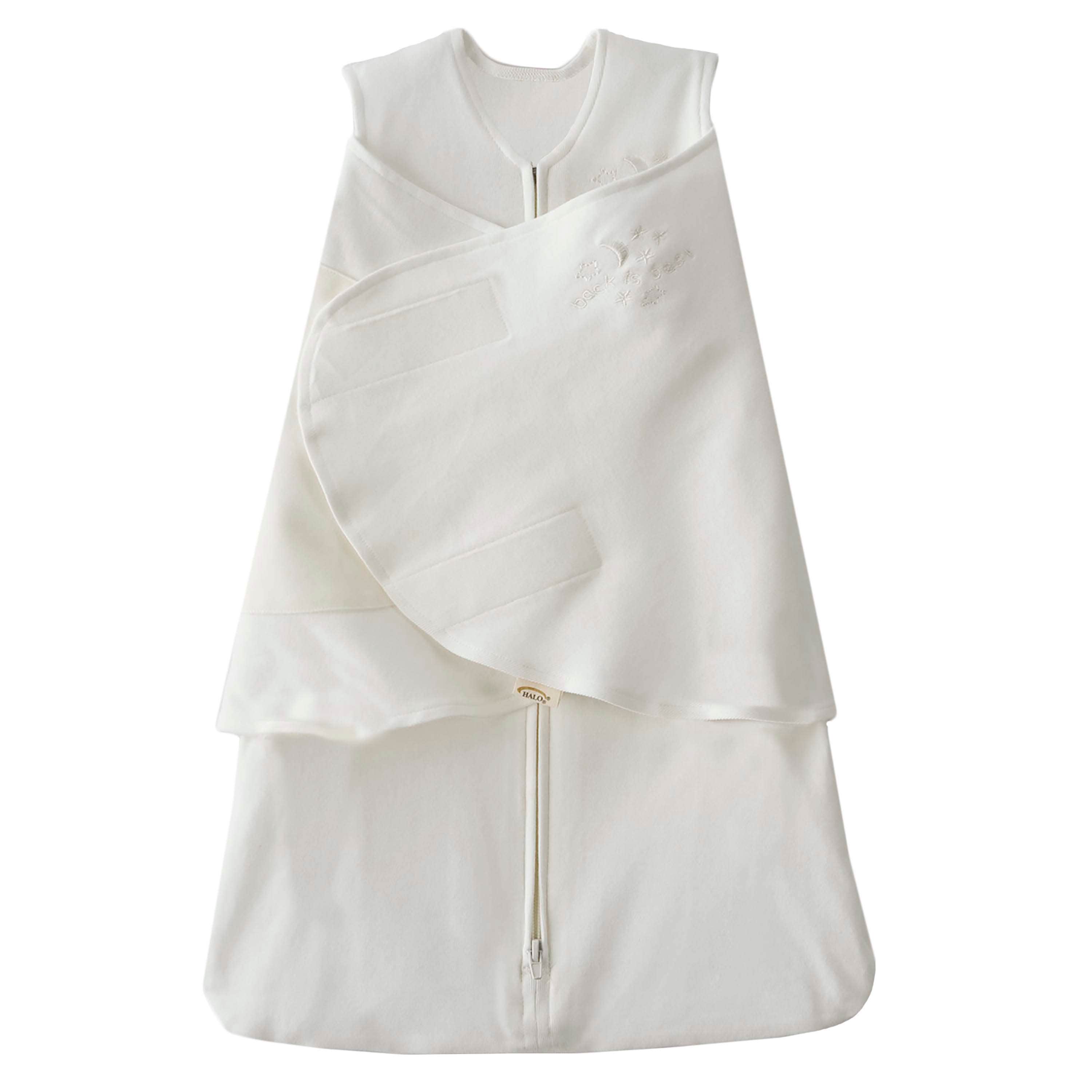
HALO SleepSack Swaddle, 100% Organic Cotton
Best for: A hip-healthy zip-up sack for parents who don't want to learn a fold
HALO's product page describes the sack's lower section as winged specifically to support healthy hip movement, with a bottom-opening zipper for diaper changes without a full re-wrap. It's the swaddle style widely used in hospital nurseries. TOG rating is 1.5 — check that against your nursery's actual temperature rather than assuming it's right for your climate.
- Winged lower panel built for hip-healthy positioning (HALO's design description)
- Bottom-opening zipper for diaper changes without unwrapping the chest and arms
- 100% organic cotton, TOG 1.5
- No fold-and-tuck technique required — on and off in under a minute once you know the sizing
Keep in mind: Sizing runs in stages (newborn, small, etc.), so you'll likely need at least one size-up purchase before this swaddling window ends around the 2-month rolling mark.

SwaddleMe Original Swaddle, 100% Cotton Muslin
Best for: A lighter, faster-to-adjust wrap for warmer rooms or a smaller newborn
SwaddleMe's design uses two adjustable hook-and-loop wings that wrap snugly around the body in three steps, which is faster to get consistently right than a fold-and-tuck blanket while still leaving hip and leg room when wrapped correctly. The lightweight cotton muslin runs cooler than a padded sack. Kids2 (the manufacturer) sizes the smallest version down to about 7 pounds.
- Adjustable hook-and-loop wings — a 3-step wrap rather than a blanket fold
- 100% cotton muslin; TOG 1.5, lighter-weight than a padded sack
- Smallest size fits newborns down to roughly 7 lbs (manufacturer spec)
- Snag-free fastener design per the manufacturer's product description
Keep in mind: One reviewer-noted quirk on the manufacturer's own listing: the second wing's attachment point sits close to the fabric edge, which can make it harder to get a consistently tight wrap compared to a zip-up sack.
As an Amazon Associate I earn from qualifying purchases. Mom's Magazine may earn a commission when you buy through links on this page, at no extra cost to you. Learn more.
Frequently Asked Questions
What's the most important swaddling safety rule?
Snug at the chest and arms, loose at the hips so knees can bend up and out, and always paired with placing baby on their back to sleep. Tight hip wrapping is linked to hip dysplasia; a swaddled baby on their stomach can't push up or reposition, which is why back sleeping matters even more with a swaddle than without one.
When exactly should I stop swaddling?
As soon as your baby shows any early sign of trying to roll — pushing up on forearms, rocking to one side — not at a fixed age. That's often around 2 months but can start earlier. Waiting until a baby fully rolls is too late; the risky window is the stage where they can roll onto their stomach but can't yet reliably get back or lift their head clear.
My baby hates being swaddled. Do I have to do it anyway?
No. Some newborns settle better with arms free from the start. Swaddling is a tool that helps a lot of babies sleep longer by limiting the startle reflex, not a requirement — if your baby fights it every time, arms-free sleep (still on the back) is a completely fine alternative.
Is a blanket swaddle or a wearable sack safer?
A correctly done blanket swaddle is safe, but a wearable sack (zipper or adjustable wings) is easier to get consistently right and can't work loose into stray bedding overnight the way an imperfectly tucked blanket can. If you're not confident in your blanket technique, a sack removes that variable.
Can I swaddle my baby in the car seat or a carrier?
No — never. A car seat harness and a baby carrier's straps both need a baby's arms and shoulders positioned specifically to work correctly, and a swaddle interferes with that regardless of how snug and otherwise safe it is. Swaddle for sleep only, not for travel in a harness.
Sources & Further Reading
- Swaddling: Is it Safe for Your Baby? — American Academy of Pediatrics (HealthyChildren.org) (reviewed 2026-09-01)
- Hip-Healthy Swaddling — International Hip Dysplasia Institute (reviewed 2026-09-01)
Related Guides

Newborn Sleep: What to Expect in the First Weeks
A realistic look at newborn sleep in the first weeks — plus the safe-sleep basics every parent should know.

"Is This Normal?" 10 Newborn Behaviors That Surprise New Parents
The startling-but-normal things newborns do — from noisy breathing to "newborn blindness" — and the few real red flags that mean call your pediatrician.

Baby and Toddler Sleep Regressions by Age: What's Happening at 4, 8, and 18 Months
Why sleep suddenly falls apart at 4 months, 8 months, and around 18 months, what's actually driving each one developmentally, and what to do differently (and not differently) at each stage.
How to Bathe a Newborn Safely: Sponge Baths, Cord Care, and How Often
Why newborns get sponge baths instead of tub baths at first, how long that actually lasts, and the step-by-step sequence that keeps a slippery, often-screaming baby safe.
Mom's Magazine Editorial Team
Editorial Team
The Mom's Magazine editorial team researches and writes practical, plainly-sourced guidance for parents and families. Guides are reviewed for accuracy and updated as recommendations change. Where a topic calls for professional expertise, we cite reputable organizations and, for health topics, add a qualified reviewer before publishing.
Newsletter
Get the Weekly Mom List
One short email a week: the most useful guides, activities, and picks for your family. No spam, unsubscribe anytime.