Products
Best Toddler Books About Big Feelings (2026): Five Picks That Build Real Emotional Vocabulary
Five picture books that name a specific feeling instead of just illustrating a meltdown — and why that specificity is what actually gives a toddler a word to reach for.
As an Amazon Associate I earn from qualifying purchases.Some links on this page are affiliate links. If you buy through them, Mom's Magazine may earn a small commission at no extra cost to you. It never changes which products we recommend. How we recommend products.
The picture books that hold up best for teaching toddlers about feelings are the ones that name one specific emotion at a time and pair it with something concrete — a color, a face, a body sensation — rather than books that just show a character having a generic meltdown. Five that do this well: The Color Monster (matches colors to feelings), In My Heart: A Book of Feelings (describes how each feeling shows up in the body), When Sophie Gets Angry — Really, Really Angry... (a Caldecott Honor book that follows anger from trigger to calm-down, not just the outburst), The Way I Feel (rhyming, one feeling per spread), and Llama Llama Mad at Mama (a specific, relatable tantrum scenario a toddler will recognize). None of these replace in-the-moment coaching during an actual meltdown — they build the vocabulary a toddler can reach for once the coaching starts working.
Best for Sorting Feelings
The Color Monster: A Story About Emotions
Best for: Sorting feelings into distinct, visual categories
Quick picks
| Product | Best for | |
|---|---|---|
| The Color Monster: A Story About Emotions Best for Sorting Feelings | Sorting feelings into distinct, visual categories | Check price on Amazon |
| In My Heart: A Book of Feelings Best for Body-Sensation Language | Connecting a feeling to how it actually feels in the body | Check price on Amazon |
| When Sophie Gets Angry — Really, Really Angry... Best Full Story Arc | Modeling a complete anger-to-calm arc, not just the outburst | Check price on Amazon |
| The Way I Feel Best Range of Feelings | A simple, rhyming one-feeling-per-page structure | Check price on Amazon |
| Llama Llama Mad at Mama Most Relatable Scenario | A specific, relatable public-meltdown scenario | Check price on Amazon |
A toddler who's mid-meltdown doesn't need a bigger vocabulary — they need the meltdown to end. But the words that make the next meltdown shorter, or make it possible for a three-year-old to say "I'm mad" instead of throwing a truck, mostly get built in the calm minutes before and after, not in the moment itself. That's the actual job of a good feelings book, and it's a narrower job than the crowded "emotions books for kids" shelf usually delivers on.
Why naming the feeling is the whole point
The CDC's positive parenting guidance for toddlers points parents toward helping a child identify and label what they're feeling as one of the more concrete, teachable pieces of handling big emotions — not as a nice-to-have on top of discipline, but as part of it. A toddler who can point to a page and say "that's me, that's mad" has a tool a toddler who's only ever heard "calm down" doesn't have yet. That's the filter we used here: does this book actually hand a toddler a specific word, or does it just illustrate the chaos without naming what caused it.
How we picked these five
This is a researched roundup built around one narrow, checkable standard — we didn't run a side-by-side panel test with a group of toddlers, and we're not claiming to. What we compared instead was how directly each book names a specific feeling versus just depicting a generic tantrum, whether it shows any path back to calm rather than ending on the outburst, and whether it's held up long enough in print to have a track record with real households.
- Names at least one specific feeling per spread — mad, scared, jealous, proud — not just "big feelings" in the abstract
- Shows some path from the feeling to a calmer state, even a simple one, rather than ending mid-outburst
- Currently in print, with a track record longer than a single publishing season
- Age range that actually includes toddlers (roughly 18 months to 4 years), not just preschool and up
The five picks
The Color Monster gives every major feeling its own color — red for anger, blue for sadness, yellow for happiness — and has the monster literally get untangled and sorted jar by jar, which makes it one of the more visual, hands-on ways to introduce the idea that feelings are separable things, not one overwhelming blob. In My Heart: A Book of Feelings skips color-coding for something more physical: it describes how each feeling actually shows up in the body (a heart that feels like it's "bursting" with joy, one that feels "heavy" with sadness), which lines up well with how young a toddler's felt sense of an emotion usually develops ahead of the word for it. When Sophie Gets Angry — Really, Really Angry... is the most narratively complete of the five: it follows one specific trigger (a toy dispute with a sibling) through Sophie's anger, her physical response (running outside, climbing a favorite tree, crying it out), and her return to the family, modeling the entire arc rather than freezing on the outburst — it's also a Caldecott Honor book, which reflects more than three decades of staying in active use. The Way I Feel uses a simple rhyming structure with one feeling per spread — silly, shy, jealous, proud, scared — in kid-drawn-style illustrations that read as approachable rather than polished, which some toddlers respond to more than glossier art. Llama Llama Mad at Mama is the most situationally specific: a shopping-trip meltdown that a lot of toddlers (and parents) will recognize immediately, which makes it useful less as a vocabulary primer and more as a "that's exactly what happened to me" mirror.
| Best for | Format | Feeling(s) covered | |
|---|---|---|---|
| The Color Monster | Sorting feelings into distinct, visual categories | Board book (also picture book/pop-up editions) | Anger, sadness, fear, happiness, calm |
| In My Heart | Connecting a feeling to a physical body sensation | Hardcover, padded board pages | Joy, sadness, bravery, anger, calm, and more |
| When Sophie Gets Angry | Modeling a full anger-to-calm arc, not just the outburst | Hardcover/paperback picture book | Anger, specifically |
| The Way I Feel | A simple, rhyming one-feeling-per-page structure | Hardcover and board book editions exist | Silly, shy, jealous, proud, scared, and more |
| Llama Llama Mad at Mama | A specific, relatable public-meltdown scenario | Hardcover picture book | Frustration/tantrum, specifically |
Read it outside the meltdown, not during it
A toddler mid-tantrum has no bandwidth for a lesson — that's not the moment to reach for the book. Read these at a calm time (bedtime, after breakfast) so the word is already familiar before it's needed. The payoff shows up later, not in the moment you're reading.
How to use these instead of just reading them once
- Read the same one repeatedly for a stretch rather than cycling through all five in a week — repetition is what makes the vocabulary stick, not variety.
- Point at the character's face and ask "what do you think they're feeling?" before you turn the page, once your toddler is old enough to guess.
- After a real meltdown has fully passed, connect it back: "you were mad like Sophie was mad, remember?" — not during the meltdown, only after.
- Keep one of these within reach at the actual moment feelings tend to run high (post-nap, pre-dinner) rather than shelved somewhere you rarely visit.
- Don't expect a book to prevent tantrums — the goal is a vocabulary word available sooner, not a toddler who stops having big feelings.
What we'd skip
Books that only depict the outburst — a character screaming or crying with no resolution shown at all — are common on this shelf and don't do much beyond validating that big feelings exist, which a toddler already knows firsthand. We'd also be cautious with anything that frames a specific feeling (especially anger) as inherently bad rather than as information; a book that treats "calm down" as the entire lesson skips the harder, more useful step of naming what happened first.
Dealing with an actual meltdown right now? →These books build vocabulary for next time — this guide covers what to actually do in the moment.
Which format for which age
Board book and padded-hardcover editions hold up to a toddler's handling — mouthing, dropping, page-flipping without much finesse — better than a standard paper picture book does, so for a toddler under roughly 2.5 who still treats books as partly a chew toy, prioritize the sturdier edition even if the "real" picture-book version has richer illustrations. By 3 to 4, most kids can handle standard paper pages without shredding them, and the longer text and more detailed art in a full picture-book edition (Sophie and Llama Llama both work well here) tends to hold attention better than a board book's simplified text at that age.
A few common scenarios, specifically
Your toddler insists "I'm not mad!" while clearly furious
This is common and isn't defiance — young toddlers often haven't yet connected the physical sensation to the label, even one they've heard in a book. Naming it for them gently ("it's okay to be mad, I can see you're mad") rather than arguing the point tends to land better than insisting on the correct label in the moment.
Your toddler only copies the crying, not the calm-down part
That's a normal, early stage of using these books — the dramatic part (Sophie's yelling, the monster's tangled mess) is easier to imitate than the quieter resolution. Keep reading to the calm ending every time rather than stopping once the exciting part is over; the resolution is the part that takes longer to sink in and needs more repetition to register.
If hitting or biting tends to show up alongside the big feelings these books are naming, our guide to toddler hitting and our guide to toddler biting both cover the in-the-moment response — the books here are the calm-time complement to that, not a replacement for it.
Using these with more than one kid, or outside the house
A feelings book works differently in a group than it does one-on-one at home, and it's worth adjusting expectations rather than assuming it'll land the same way. At daycare or in a sibling read-along, a toddler who's watching a peer or an older sibling engage with the book tends to pick up less of the vocabulary directly and more from copying the other child's reaction — which is still useful, just slower and less predictable than a quiet one-on-one read. If a specific feeling is a recurring flashpoint between siblings (jealousy over attention, frustration over sharing), it's worth mentioning to a daycare provider or babysitter which book you've been using at home so the same word gets reinforced in both settings rather than two different vocabularies developing in parallel.
What to do if a caregiver hasn't read any of these
That's fine — the book itself isn't magic, and a caregiver who consistently names feelings out loud ("I can see you're frustrated") is doing the same underlying work without ever cracking a specific spine. If you do want consistency across settings, a quick note about which word or book you're using at home ("we've been reading The Color Monster, so 'red' has become our shorthand for angry") is a low-effort way to bridge the two without asking a caregiver to buy or read anything new.
Our Recommendations

The Color Monster: A Story About Emotions
Best for: Sorting feelings into distinct, visual categories
A monster wakes up with all its feelings tangled together and sorts them into color-coded jars — red for anger, blue for sadness, yellow for happiness — which makes the abstract idea that feelings are separate, nameable things concrete for a toddler.
- Color-coded feelings (anger=red, sadness=blue, etc.)
- Pop-up and board book editions available
- Simple enough for a 2-year-old, detailed enough to revisit at 4
- Companion activity books and a matching plush monster set exist
Keep in mind: The color-coding is a simplification — real feelings mix more than one jar at a time, which is worth saying out loud as your toddler gets older.

In My Heart: A Book of Feelings
Best for: Connecting a feeling to how it actually feels in the body
Describes each feeling by its physical sensation — a heart that feels like it's bursting with joy, or heavy with sadness — which meets toddlers where they actually are: feeling something in the body well before they have the word for it.
- Die-cut heart window on each spread
- Physical, sensory language rather than just labels
- Part of the wider Growing Hearts board book series
- Padded hardcover holds up to handling
Keep in mind: Less narrative than a story-driven pick like Sophie or Llama Llama — it's closer to a reference book than a story.

When Sophie Gets Angry — Really, Really Angry...
Best for: Modeling a complete anger-to-calm arc, not just the outburst
A Caldecott Honor book that follows one specific trigger (a toy dispute with a sibling) through Sophie's anger, a physical release outdoors, and her calm return to the family — the fullest emotional arc of the five picks here.
- Caldecott Honor recognition
- Shows a specific, relatable trigger (sibling toy dispute)
- Models a physical release (running, climbing, crying) rather than instant calm
- Vivid, expressive illustrations that read well aloud
Keep in mind: Standard picture-book paper pages — not built for a toddler still in a tearing phase.

The Way I Feel
Best for: A simple, rhyming one-feeling-per-page structure
Rhyming text and kid-drawn-style illustrations cover a wider range of feelings than most toddler books attempt — silly, shy, jealous, proud, scared — in short, easy-to-repeat verses.
- Rhyming text, easy to read aloud from memory
- Covers less-common feelings (jealous, proud, shy) alongside the basics
- Approachable, non-glossy illustration style
- Available in hardcover and board book editions
Keep in mind: The wider range of feelings covered means less depth on any single one compared to Sophie's full-story approach.

Llama Llama Mad at Mama
Best for: A specific, relatable public-meltdown scenario
Llama has a shopping-trip meltdown that a lot of toddlers — and parents — will recognize instantly, which makes it less a vocabulary primer than a mirror: "that's exactly what happened to me" is the point, not a new word.
- Rhyming text in the familiar Llama Llama series voice
- A specific, everyday trigger (a long errand) rather than an abstract feeling
- Hardcover, padded picture-book format
- Works well alongside other Llama Llama titles a toddler may already know
Keep in mind: No board book edition currently available — the hardcover isn't built for heavy chewing/mouthing.
As an Amazon Associate I earn from qualifying purchases. Mom's Magazine may earn a commission when you buy through links on this page, at no extra cost to you. Learn more.
Frequently Asked Questions
What age should I start reading feelings books with my toddler?
Any time after about 18 months is reasonable — a toddler doesn't need to be verbal yet to start connecting a picture and a feeling word. Board-book and padded editions make more sense at the younger end of that range.
Will these books actually stop tantrums?
No, and treating them that way sets up disappointment. They build a vocabulary word a toddler can reach for sooner, not a shortcut around having big feelings in the first place — pair them with in-the-moment coaching during actual meltdowns.
My toddler wants the angry book read over and over — is that concerning?
No. Repeated requests for a specific feeling's book often just means that feeling is active for your toddler right now, and the repetition is part of how the vocabulary sinks in. It's not a sign something's wrong.
Board book or standard picture book — does it matter which edition I buy?
Mostly for durability, not content. If your toddler still mouths or tears books, prioritize the board or padded-hardcover edition even if a richer standard picture-book version exists for the same title.
Is it better to read these before or after a meltdown?
Both have a place, but calm, ordinary reading time (bedtime, after breakfast) is where the vocabulary actually gets built. Reconnecting to the book briefly after a meltdown has fully passed can help a toddler label what just happened, but reading mid-meltdown rarely lands.
Sources & Further Reading
- Positive Parenting Tips: Toddlers (2–3 years old) — Centers for Disease Control and Prevention (reviewed 2026-08-31)
- Early Literacy — American Academy of Pediatrics (reviewed 2026-08-31)
Related Guides
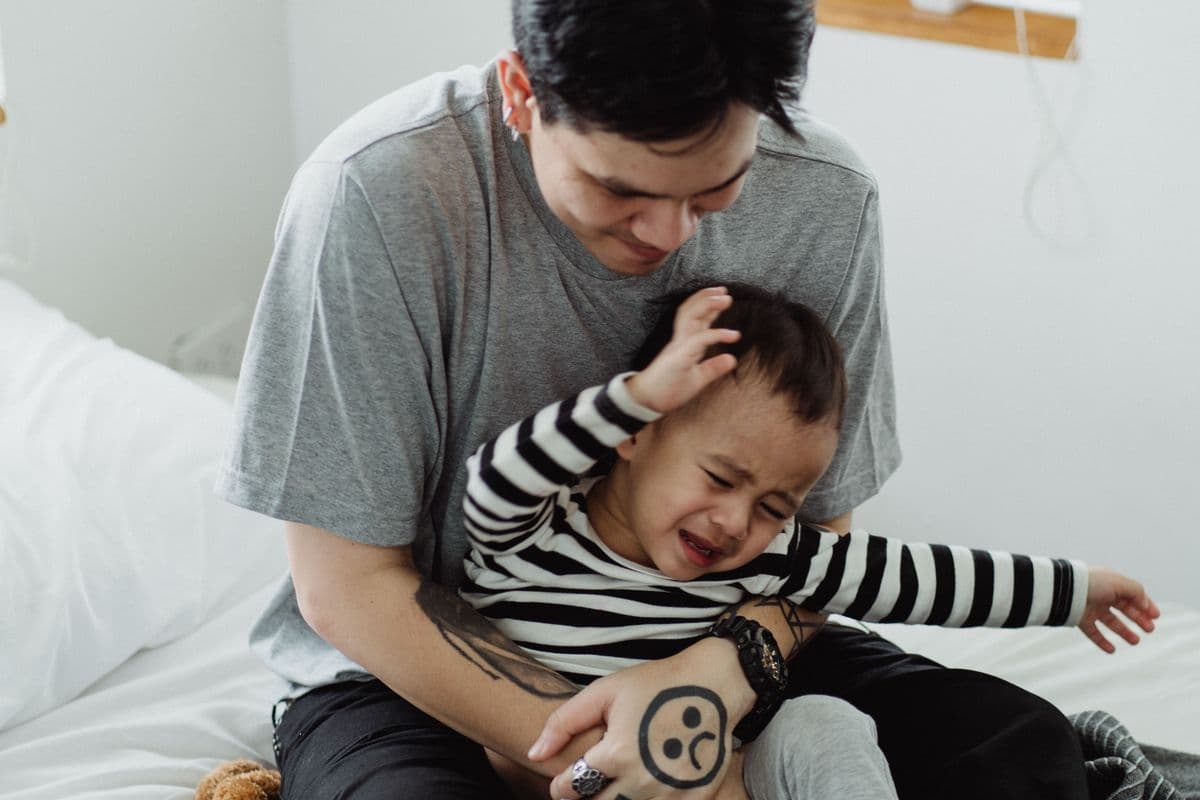
How to Handle Toddler Tantrums: Real Help That Works, According to AAP and CDC
Help with toddler tantrums, how to handle toddler tantrums, and how to deal with toddler tantrums, using AAP, CDC, and NIH pages: what actually helps in the moment, an age-by-age look at what's typical at 1, 2, and 3, tantrums by setting (car seat, store, bedtime, drop-off), how to prevent the next one, and when to call your pediatrician. Editorially reviewed general information — not medical advice.
How to Handle Toddler Hitting: What to Do, According to AAP
Why toddlers hit before they have the words to say what's wrong, the AAP's actual script for responding in the moment, and the difference between discipline and punishment that most advice skips.
How to Handle Toddler Biting
Why toddlers bite, the calm-and-firm response that actually reduces it, and when biting is more than a developmental phase.
Best Books for Toddlers 2026: Board Books That Survive Toddlerhood
Five toddler books that have stayed in print for decades, why durability and read-aloud rhythm matter more than a flashy cover, and what the AAP actually says about reading with toddlers.
Mom's Magazine Editorial Team
Editorial Team
The Mom's Magazine editorial team researches and writes practical, plainly-sourced guidance for parents and families. Guides are reviewed for accuracy and updated as recommendations change. Where a topic calls for professional expertise, we cite reputable organizations and, for health topics, add a qualified reviewer before publishing.
Newsletter
Get the Weekly Mom List
One short email a week: the most useful guides, activities, and picks for your family. No spam, unsubscribe anytime.